A Short History of Apple Intelligence (and the Siri That Kept Slipping)
How Apple Intelligence went from a big 2024 stage promise to what actually shipped, and why the personal-context Siri took until 2026. Part 2 of a 6-part series on local AI.
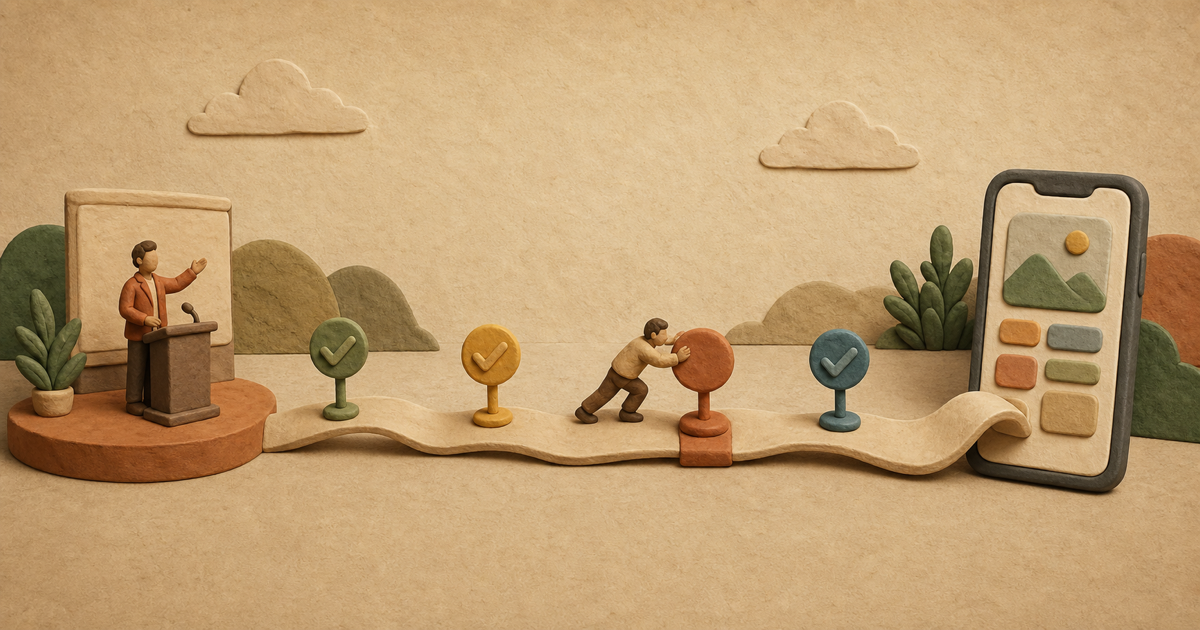
This is Part 2 of a 6-part series on Apple Intelligence. Start with Part 1: What Is Apple Intelligence? if you missed it.
Two years ago Apple demoed a version of Siri I actually wanted: one that could read my screen, remember who I was just talking to, and take actions across my apps. Then the best part of that demo took another two years to ship.
The gap between what Apple promised in June 2024 and what actually landed is the most interesting part of this story, so that gap is what I want to walk through here.
The promise: WWDC 2024
Apple announced Apple Intelligence at WWDC on June 10, 2024. The pitch had two distinct halves, and the difference between them is the whole plot.
The first half was language and image features: rewriting and proofreading text, summarizing long emails, cleaning objects out of photos, making custom emoji. Useful, contained, and (as it turned out) shippable.
The second half was the showstopper, a rebuilt Siri with three new powers:
- Personal context: it knows the people, files, and messages in your life.
- Onscreen awareness: it can see what you’re looking at.
- In-app actions: it can actually do things across your apps.
That second half was the “your phone finally has a real assistant” promise. It’s also the piece that slipped.
What actually shipped first
The language and image half arrived roughly on schedule, spread across three releases:
- iOS 18.1, October 28, 2024: the real launch. Writing Tools (rewrite, proofread, summarize), Clean Up in Photos, mail and notification summaries, and a redesigned Siri with a glowing screen edge, Type to Siri, and a more natural voice.
- iOS 18.2, December 11, 2024: Image Playground, Genmoji, Visual Intelligence (point your camera and ask about what you see), and the ChatGPT hand-off for open-ended questions.
- iOS 18.4, March 31, 2025: priority notifications and a batch of new languages.
That redesigned Siri in 18.1 was mostly a new look and better manners, not the deep assistant from the demo. It held a conversation a little better and answered questions about your own device. It still could not reach into your apps and get things done. And the personal-context Siri, once penciled in for around iOS 18.4, was not in the box.
The Siri that kept slipping
The deeper Siri was the single most-anticipated feature, and it was the one Apple could not get out the door.
- March 7, 2025: Apple publicly admitted the delay, saying the work would “take us longer than we thought” and pushing it into “the coming year.” That was an unusually candid thing for Apple to say out loud.
- WWDC 2025, June 9, 2025: still no personal Siri. The event pivoted to developers instead: the Foundation Models framework (which opens the on-device model to any app, the subject of Parts 3 and 5), Live Translation, and AI actions inside Shortcuts. It also came with a naming curveball: Apple renamed its operating systems to year-based numbers, and iOS jumped straight from 18 to iOS 26.
- Early 2026: a planned iOS 26.4 release ran into testing problems (the new Siri was mishandling queries and responding slowly), and the features slipped again.
- WWDC 2026, June 8, 2026: it finally reappeared, rebranded “Siri AI.” This is the version with real personal context, onscreen awareness, systemwide app actions, a dedicated Siri app, and a Dynamic Island entry point.
One caveat that a lot of the coverage gets wrong: as of today Siri AI is still in beta, not generally released. It went to developers in June, is reaching public beta around now, and the general release is expected this fall alongside iOS 27. So the assistant Apple demoed in 2024 is real and testable in 2026, but most people still don’t have it.
There’s a second thread worth flagging, and I’ll hedge it because Apple has not confirmed the juicy part. Reporting from Bloomberg says Apple is paying Google around a billion dollars a year for a custom model to handle some of Siri’s cloud-side reasoning, running on Apple’s own private servers. Apple’s own language is much drier: it says its top server model was “custom-built in collaboration with Google.” Apple never says “Gemini.” I’d treat the billion-dollar-Gemini version as reporting, not gospel, and Part 4 comes back to what it means for privacy.
How this relates to the old Siri
If you’ve had an iPhone for a while, it’s fair to ask where the Siri you already knew fits in. Siri launched back in 2011, and for most of its life it was a command matcher: it recognized a fixed menu of phrasings (“set a timer,” “call Mom”) and fell back to a web search for anything off the script.
Siri is the front desk; Apple Intelligence is the new staff behind it. Same desk you’ve always walked up to, but the people answering got a lot more capable. The 2011 Siri and the 2026 Siri AI are the same brand and the same “hey, do this for me” doorway. What changed is the intelligence sitting behind the door.
The “personal context” part gets concrete fast. Say a friend texts you her address, and a minute later you want to send her a photo. With the old Siri, “send her the file” is gibberish, because it has no idea who “her” is or which file you mean. The new Siri is supposed to resolve “her” and “the file” to the right people and things, because it can see the context you’re already sitting in. That one capability is most of why this took years and not months.
My read
Watching the sequence, the pattern looks deliberate to me: Apple shipped the safe stuff early and held the risky stuff back.
The language and image features are low-stakes. If Writing Tools mangles a sentence, you fix it and move on. An assistant that takes actions across your apps using your personal data is a different risk class. When it’s wrong, it can send the wrong thing to the wrong person, and it’s touching your most sensitive context to do it. That’s exactly the kind of feature Apple, of all companies, cannot afford to ship half-baked.
So the delay reads less like Apple falling behind and more like Apple refusing to ship the dangerous version until it clears their bar. You can argue they over-promised at that 2024 keynote (I think they did), but what they chose to hold back is consistent with how they usually operate. Whether that caution pays off is a Part 6 question.
What’s next
Part 3 opens up the actual machinery: the two Apple models (the small one on your phone and the bigger one in the cloud), how they decide which one handles your request, and a data point I found genuinely surprising about how your phone stacks up against an expensive Mac.
If you want the rest as it drops this week, the site has an RSS feed you can point your reader at.
Frequently asked questions
When did Apple Intelligence come out? Apple announced it at WWDC on June 10, 2024, and shipped the first features on October 28, 2024 with iOS 18.1. More features arrived across iOS 18.2 (December 2024) and 18.4 (March 2025).
Why was the new Siri delayed? The deeper, personal-context Siri shown in 2024 turned out to be harder than expected. Apple publicly delayed it in March 2025, it slipped past iOS 26 and a planned iOS 26.4 release amid testing problems, and it was reintroduced as “Siri AI” at WWDC 2026.
Is the new Siri available now? As of mid-2026 it’s in beta, not a general release. It reached developers in June 2026 and is expected to launch publicly this fall alongside iOS 27.
What is the difference between Siri and Apple Intelligence? Siri is the assistant you talk to. Apple Intelligence is the broader system underneath it (writing tools, image features, summaries, and the models). Siri is one of several things Apple Intelligence upgrades.
Why did iOS jump from 18 to 26? At WWDC 2025 Apple switched to year-based version numbers, so iOS 18 was followed by iOS 26 (roughly the 2025 model year). The 2026 generation is iOS 27.
Sources
- Introducing Apple Intelligence (Apple Newsroom, June 2024)
- Apple Intelligence is available today (Apple Newsroom, October 2024)
- Image Playground, Genmoji, and more (Apple Newsroom, December 2024)
- The more personalized Siri is delayed (TechCrunch, March 2025)
- Apple Intelligence gets more powerful (Apple Newsroom, WWDC 2025)
- Siri features delayed past iOS 26.4 (MacRumors, February 2026)
- Apple introduces Siri AI (Apple Newsroom, June 2026)