The Two Apple Intelligence Models, and How Your Phone Decides
A plain-English tour of Apple's on-device model, Private Cloud Compute, and the ChatGPT tier, plus the surprising reason your iPhone and an expensive Mac aren't as far apart as you'd think. Part 3 of a 6-part series on local AI.

This is Part 3 of a 6-part series on Apple Intelligence. Start with Part 1: What Is Apple Intelligence? if you missed it.
I went in assuming my Mac would run circles around my iPhone at on-device AI. It has a bigger chip, more room, more everything. Then I looked at the numbers and the part of the chip that actually runs the model is close to a tie. The place they really diverge turned out to be somewhere I didn’t expect: memory.
That starts with the model on the phone.
What’s actually running on your phone
The thing doing the work is small. Apple’s on-device model is about 3 billion parameters (the adjustable knobs a neural network tunes during training), a number Apple has repeated across its 2024, 2025, and 2026 reports. For comparison, the big cloud models are widely believed to be hundreds of billions to over a trillion, though the frontier labs mostly don’t publish exact counts.
The mental picture I keep coming back to is a sharp junior assistant sitting at a desk: fast, always there, works offline, costs nothing to ask, and only walks down the hall to a specialist for the genuinely hard stuff. Getting a capable model down to that desk takes two tricks worth knowing by name.
The first is quantization. Think of it like compressing a photo: you round the millions of tiny numbers in the model to fewer decimal places so the whole thing fits on a phone, and you lose barely any sharpness. Apple has quantized more aggressively each year (roughly 3.5 to 3.7 bits per weight in 2024, a 2-bit decoder in 2025 using training that expects the compression), so the exact number depends on the year you’re asking about.
The second is LoRA adapters. Picture one power drill with a set of snap-on bits: same motor, swapped tip. The base model is the motor, and each adapter (only tens of megabytes) is a bit for a specific job (summarize, proofread, draft a reply). Apple loads and swaps them on the fly, so one small model can specialize on demand without shipping a dozen separate models.
How good is a 3-billion-parameter model, really?
Better than its size suggests, and Apple is refreshingly honest about where it falls short. Here are the numbers from Apple’s 2025 tech report, where higher is better.
On-device model (~3B):
| Model | MMLU | MMMLU | MGSM |
|---|---|---|---|
| Apple on-device | 67.85 | 60.60 | 74.91 |
| Qwen-2.5-3B | 66.37 | 56.53 | 64.80 |
| Qwen-3-4B | 75.10 | 66.52 | 82.97 |
| Gemma-3-4B | 62.81 | 56.71 | 74.74 |
Apple’s small model beats Qwen-2.5-3B and Gemma-3-4B on the knowledge benchmarks, and trails the larger Qwen-3-4B. That’s a fair result for something running on your phone with no network.
The cloud story is more humbling. On these three text benchmarks, Apple’s server model trails all three comparators:
| Model | MMLU | MMMLU | MGSM |
|---|---|---|---|
| Apple server | 80.20 | 74.60 | 87.09 |
| Llama-4-Scout | 84.88 | 80.24 | 90.34 |
| Qwen-3-235B | 87.52 | 82.95 | 92.00 |
| GPT-4o | 85.70 | 84.00 | 90.30 |
Apple’s server model is good, but it isn’t beating the larger frontier models in Apple’s own table. That’s worth remembering, because Apple’s pitch here is privacy and cost rather than topping a leaderboard.
One more number makes the quantization point concrete. On MMLU, Apple’s compression pass costs the on-device model about 3.4 points and the server model about 0.8 (67.8 to 64.4, and 80.0 to 79.2). You shrink the model to fit the hardware and give up a few points of accuracy for it.
The three tiers, and how your request gets routed
When a request lands, the system decides which of three places should handle it. I used the assistant-at-a-desk picture in Part 1, and it’s worth having in front of you here.
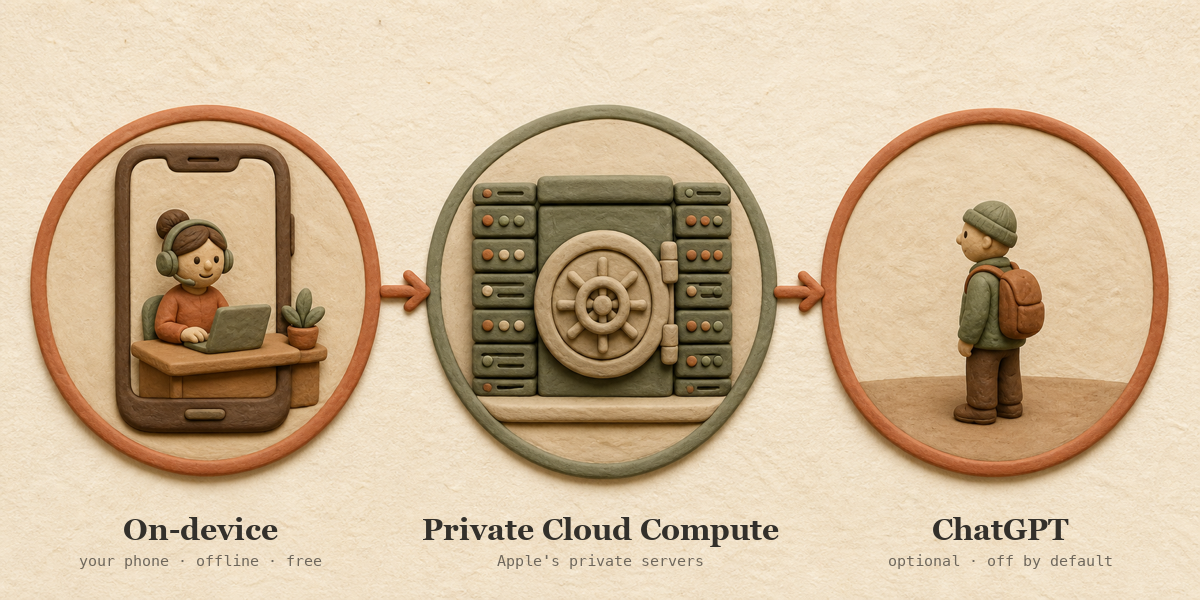
- The desk (on-device). The ~3B model handles many routine requests right on your phone or Mac, offline and free. This is where Apple wants the work to happen.
- The locked, audited room (Private Cloud Compute). When a request is too heavy for the desk, it goes to a specialist team behind a locked door, on Apple’s private servers built so your data isn’t stored and no one (by Apple’s design, not even Apple) can look inside. The privacy machinery here is the whole subject of Part 4.
- The outside consultant (ChatGPT). For open-ended world-knowledge questions, there’s an optional hand-off to ChatGPT, and it behaves like calling in an outsider: by default your phone asks before handing anything over (you can switch off the repeat confirmation for Siri requests, though files and photos always ask).
One distinction that trips people up: ChatGPT is not Apple’s cloud engine. ChatGPT is the opt-in extension for questions that need broad world knowledge. The heavy lifting inside Private Cloud Compute runs on Apple’s foundation models. There’s also a separate wrinkle worth hedging carefully: Bloomberg has reported that Apple is paying Google around a billion dollars a year for a custom model to help power Siri’s cloud reasoning. Apple’s own language is drier, saying only that its top server model was “custom-built in collaboration with Google” and runs on NVIDIA GPUs in Google Cloud. Apple has acknowledged drawing on the technology behind Google’s Gemini models, but it doesn’t brand the model powering Siri “Gemini” or confirm the billion-dollar figure. Treat those specifics as reporting, not Apple’s word (Part 4 digs into what the arrangement means for privacy).
The surprising part is memory
Here’s the thing that flipped my assumption. The chip inside these devices has a dedicated block for AI work called the Neural Engine, measured in TOPS (trillions of operations per second). The iPhone’s A17 Pro and A18 are commonly reported at 35 TOPS. Apple’s base Mac chips: M1 at 11, M3 at 18, M4 at 38. So on raw AI throughput, a recent iPhone rivals or beats a base Mac. The Neural Engine is close to a tie.
| Chip (device) | Neural Engine (TOPS) | Max unified memory |
|---|---|---|
| A17 Pro / A18 (iPhone) | ~35 | 8 GB |
| M1 | 11 | 16 GB |
| M3 | 18 | 24 GB |
| M4 | 38 | 32 GB |
| M1 Ultra | 22 | 128 GB |
| M3 Ultra | 36 | 512 GB |
The throughput column stays in a tight band. The memory column runs from 8 GB to 512 GB, about a 64x spread, and that is the gap that actually decides how big a model a device can hold.
Where they pull apart is memory. Apple doesn’t publish iPhone RAM, but teardown and Xcode reporting put the supported iPhones at 8 GB. Supported Apple silicon Macs range from older 8 GB machines up to 512 GB on an M3 Ultra, roughly a 64x spread. Memory bandwidth (how fast the chip can move that data) tells the same story, from about 68 GB/s on an M1 to 800+ GB/s on the Ultra chips, more than a 10x spread.
That matters because a model has to fit in memory to run, and bigger models need more of it. Your available RAM sets a rough ceiling on the size of model you can hold locally. These are conservative practical estimates for always-available local inference (the operating system needs memory too), not hard limits:
| Device memory | Rough local model ceiling |
|---|---|
| 8 GB (iPhone, base Mac) | 3B to 4B comfortably |
| 16 GB | 13B to 14B (compressed) |
| 32 GB | around 32B |
| 64 GB | around 70B |
| 128 GB+ | 100B and up |
So the honest phone-versus-Mac story starts with memory more than raw AI math: a maxed-out Mac can hold a model many times larger than anything an iPhone can. Today, Apple mostly doesn’t use that headroom, which is the setup for the interesting question.
Same everyday model on every device (for now)
Right now the everyday on-device model is basically the same ~3B model on every supported device, whether that’s an 8 GB iPhone or a Mac Studio with half a terabyte of memory. The Mac’s extra room mostly sits idle as far as Apple Intelligence is concerned.
Apple has already taken one step away from that. Its 2026 third-generation lineup added a second on-device model, AFM 3 Core Advanced, a 20-billion-parameter sparse model (it activates only 1 to 4 billion parameters at a time) that Apple says is unlocked on its most capable Apple silicon. That’s the first time Apple has gated an on-device model to better hardware.
My prediction, and I’ll flag it clearly as opinion, is that this becomes a wider strategy: Apple stops shipping one identical model to everything and offers more capable local models on higher-end devices, which conveniently also sells higher-end devices. There’s an early hint in the reporting. The Information, via MacRumors, says Apple met with a startup called PrismML that claims it compressed Alibaba’s Qwen 3.6 (27 billion parameters) to run on an iPhone 17 Pro. That’s reporting, not a shipped product, and I get into the full argument in Part 6.
What’s next
That routing design (on-device first, sealed cloud second) is the setup for Part 4, which is all about privacy: what Private Cloud Compute actually guarantees, how you’d verify it, and why “free, private, offline inference” changes what developers can safely build.
If you want the rest as it drops this week, the site has an RSS feed you can point your reader at.
Frequently asked questions
How big is Apple’s on-device AI model? About 3 billion parameters, a figure Apple has repeated across its 2024, 2025, and 2026 model reports. In 2026 Apple added a second, larger on-device model (a 20-billion-parameter sparse model) for its most capable hardware.
Does my iPhone or my Mac run on-device AI better? On raw AI throughput they’re closer than you’d think: a recent iPhone’s Neural Engine (about 35 TOPS) rivals a base Mac chip. The real gap is memory and bandwidth, where Macs range far higher, which lets them hold much larger models. Today, though, Apple ships the same everyday model to both.
What is Private Cloud Compute? It’s Apple’s private server tier for requests too heavy for your device, running on Apple silicon and designed so your data isn’t stored and Apple can’t read it. Part 4 covers how those guarantees work.
Is ChatGPT the same as Apple’s cloud model? No. ChatGPT is an opt-in extension for open-ended world-knowledge questions, and by default your phone asks before handing anything to it (files and photos always require approval). The reasoning inside Private Cloud Compute runs on Apple’s own foundation models (with a reported Google collaboration behind the top server model).
What is quantization? It’s compressing a model by rounding its numbers to fewer decimal places so it fits on smaller hardware, like compressing a photo. You lose a little accuracy (a few points on benchmarks) in exchange for fitting on a phone.
Sources
- Updates to Apple’s On-Device and Server Foundation Language Models (Apple Machine Learning Research, 2025)
- Introducing Apple’s On-Device and Server Foundation Models (Apple Machine Learning Research, 2024)
- Apple Intelligence Foundation Language Models Tech Report 2025 (arXiv 2507.13575)
- Apple’s new AI benchmarks show its models still lag behind leaders (the-decoder)
- Introducing the Third Generation of Apple’s Foundation Models (Apple Machine Learning Research, 2026)
- Private Cloud Compute (Apple Security)
- Image Playground, Genmoji, and more, incl. ChatGPT integration (Apple Newsroom, December 2024)
- Apple to pay Google for custom model to help power new Siri (MacRumors, November 2025)
- Neural Engine supported devices / TOPS (hollance)
- Neural Engine (Wikipedia)
- Apple M1 and unified memory specs (Wikipedia)
- Apple unveils M1 Ultra (Apple Newsroom, March 2022)
- iPhone 15 Pro models have 8GB RAM (MacRumors, September 2023)
- Apple met with PrismML about larger on-device AI models (MacRumors, July 2026)
- How much RAM do you need for local LLMs (Corsair)