Where Would Raleigh Actually Put an MLB Stadium? I Scored All 40,000 Parcels
With Raleigh in the MLB expansion conversation, I built a tool that ranks every developable parcel in the Triangle for a ballpark. The data's top pick landed in Tom Dundon's backyard by accident.
The Carolina Hurricanes won the Stanley Cup this month, and somewhere between the final horn and the downtown parade I found myself thinking about baseball instead of hockey.
That is because the same week the Canes were closing out the Cup, the loudest sports rumor in the Triangle was not about hockey at all. It was about Major League Baseball, and the question underneath all of it: if Raleigh actually lands a team, where on earth would you put the stadium?
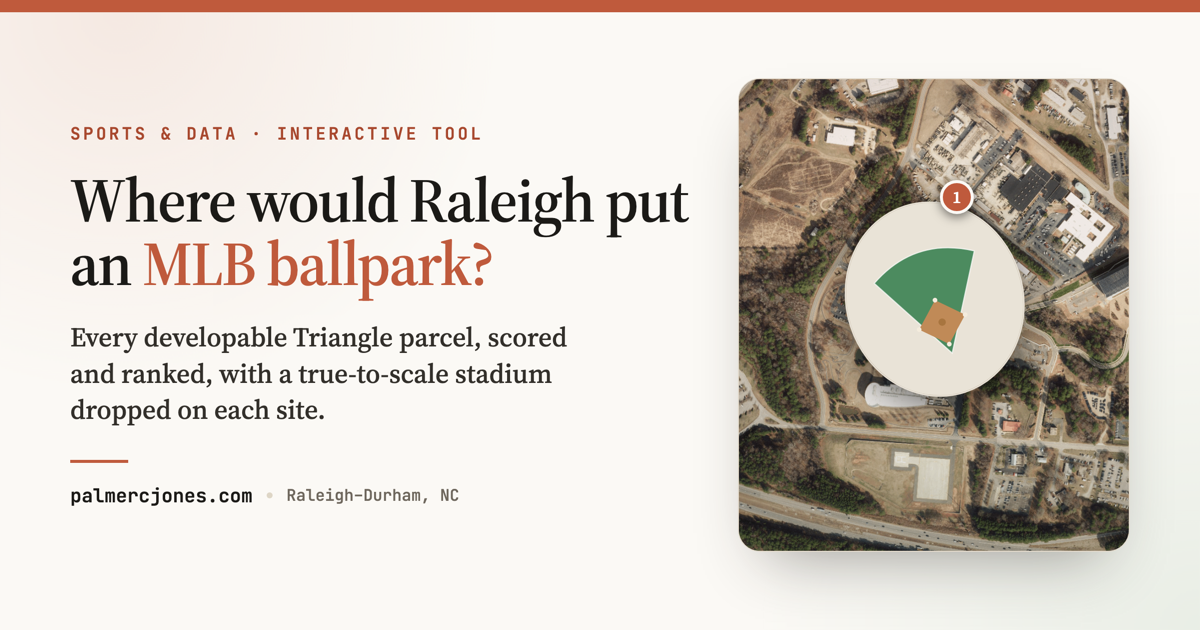
So I built a thing to answer it. I pulled every developable parcel in Wake, Durham, and Orange counties (about 40,000 of them), scored each one on how well it could hold a big-league ballpark, and ranked the survivors. You can open the whole tool here and poke at it yourself.
Here is the part I did not plan. The model’s number one site turned out to sit a few hundred feet from where Tom Dundon is already planning to build.
Raleigh is suddenly a real candidate
This is not idle daydreaming anymore. MLB Commissioner Rob Manfred has said he wants to pick two expansion cities before he retires in January 2029, which would be the league’s first expansion since 1998 (WRAL). Raleigh keeps showing up on the short lists, alongside Nashville, Salt Lake City, and Portland (ESPN).
The money is circling too. Tom Dundon, who owns the Hurricanes, has been the loudest local voice, telling WRAL right after the Cup that “if they decide to expand, we’ll have a compelling offer.” His arena business chief Brian Fork is leading that push (WRAL). Separately, investor Marc Lasry (who already backs the NC Courage) says he wants in and would partner with Dundon, adding that “Raleigh has as good a shot as anybody.”
There is even public money in the conversation. NC Senate leader Phil Berger has floated stadium provisions in the state budget, and a Wake County hotel-tax bump is one of the funding ideas being kicked around for a project estimated at roughly $4 billion (WRAL).
The case is simple. North Carolina is the largest state in the country with no MLB team, the Triangle grew 18% to 2.2 million people over the last decade, and Raleigh proper grew 25% (WRAL). A region that already supports the NHL, MLS, and the NWSL is running out of reasons not to have baseball.
So I scored every parcel
Everyone has an opinion about the site. I wanted the data to have one too.
Here is the short version of how the tool thinks. It reads every parcel of three or more acres straight from each county’s public GIS, keeps the genuinely developable ones (vacant, industrial, commercial, or public land), and fuses neighboring parcels into assembled sites big enough for a ballpark. Then it scores each site on what actually matters most: population centrality (be where the people are), transportation (interstate and rail access, pulled from OpenStreetMap), and a hard geometric fit test that checks whether a stadium-sized footprint can even fit the shape. Land type, acquisition cost, and a buffer from the Durham Bulls round it out.
The fun part is the map. Pick a site and the tool drops a true-to-scale ballpark onto the real parcel, oriented east-northeast the way real parks are (that is MLB Rule 1.04, which keeps the setting sun out of the batter’s eyes), then carves the leftover land into parking and routes the whole thing around the buildings that are already there.
The data’s pick lands in Dundon’s backyard
The top site the model spits out is 3905 Reedy Creek Road, a big piece of state-owned land out by the State Fairgrounds.
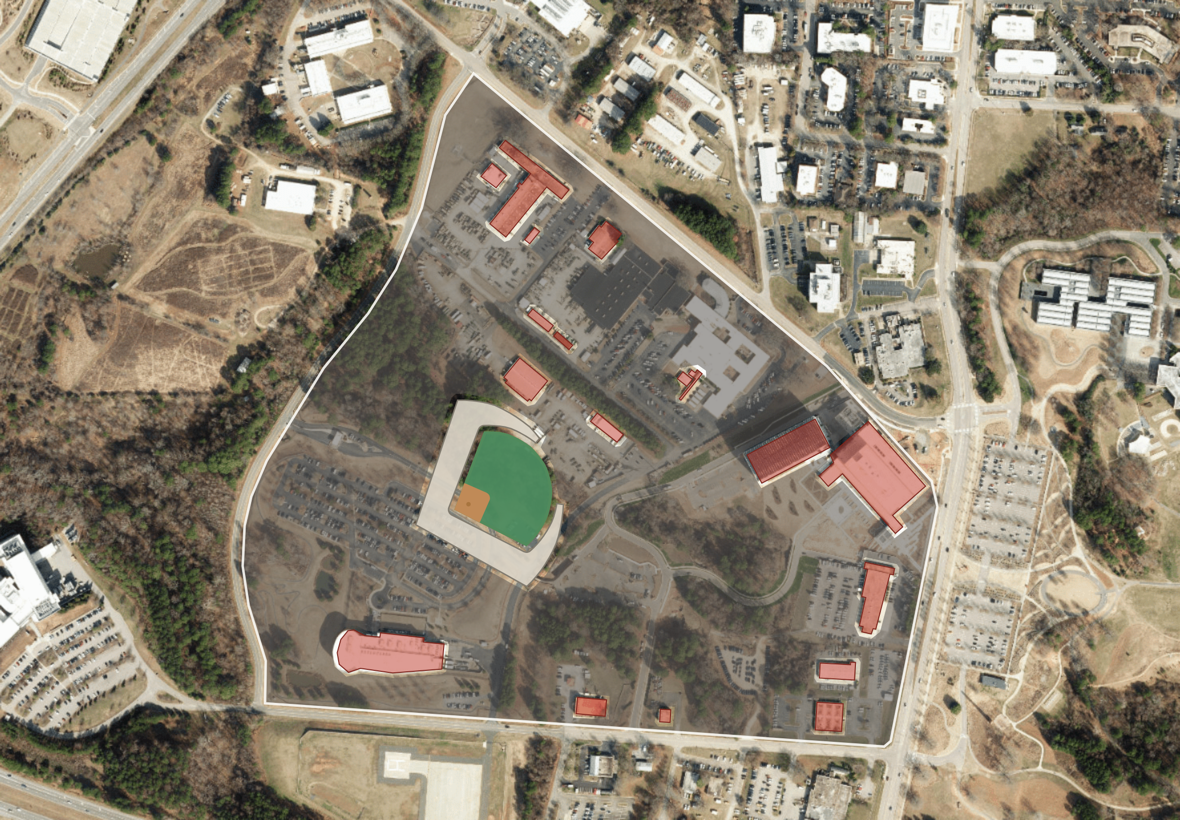
If that neighborhood sounds familiar, it should. It is right next to Lenovo Center (the arena the Hurricanes call home, formerly PNC Arena) and Carter-Finley Stadium. And it is the exact area where Dundon already holds the rights to develop 80 acres into a mixed-use entertainment district, a deal Raleigh’s City Council approved last year along with $300 million in public money for arena renovations (WRAL).
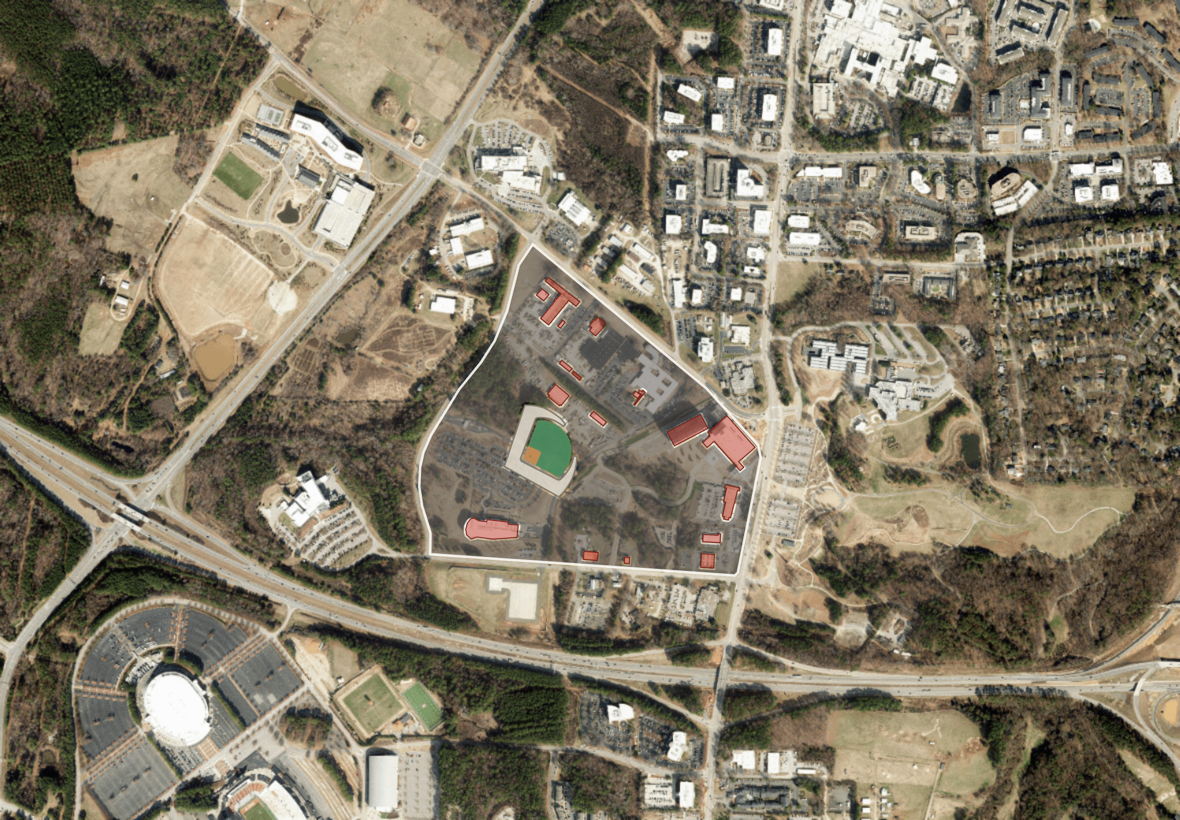
I want to be clear that the tool had no idea any of that was going on. It does not know who Dundon is. It got to Reedy Creek on cold inputs alone: an interstate interchange about 0.15 miles away, rail nearby, room for a full complex on 108 acres, and a buildable core wide enough to hold a stadium plus surface parking. The fact that the math independently agreed with the one guy who already controls land out there is, I think, the most interesting thing the whole project turned up.
The insiders have two favorites. The model has a third opinion.
The two sites that get talked about most in the real conversation are different from each other.
One is Downtown South, the Kane Realty megaproject south of downtown, a 140-acre plan with a stadium parcel off South Saunders Street near I-40 and Dix Park (Wikipedia, Axios). The other is the Lenovo Center district out west, which is Dundon’s play (Lenovo Center).
The tool likes the west-side land too, but it spreads the love around. Macon Pond Road and Jones Franklin Road both crack the top three, and an old industrial tract at Trenton Road shows what the model is really looking for: open land, a highway on the edge, and a footprint that fits without bulldozing much.
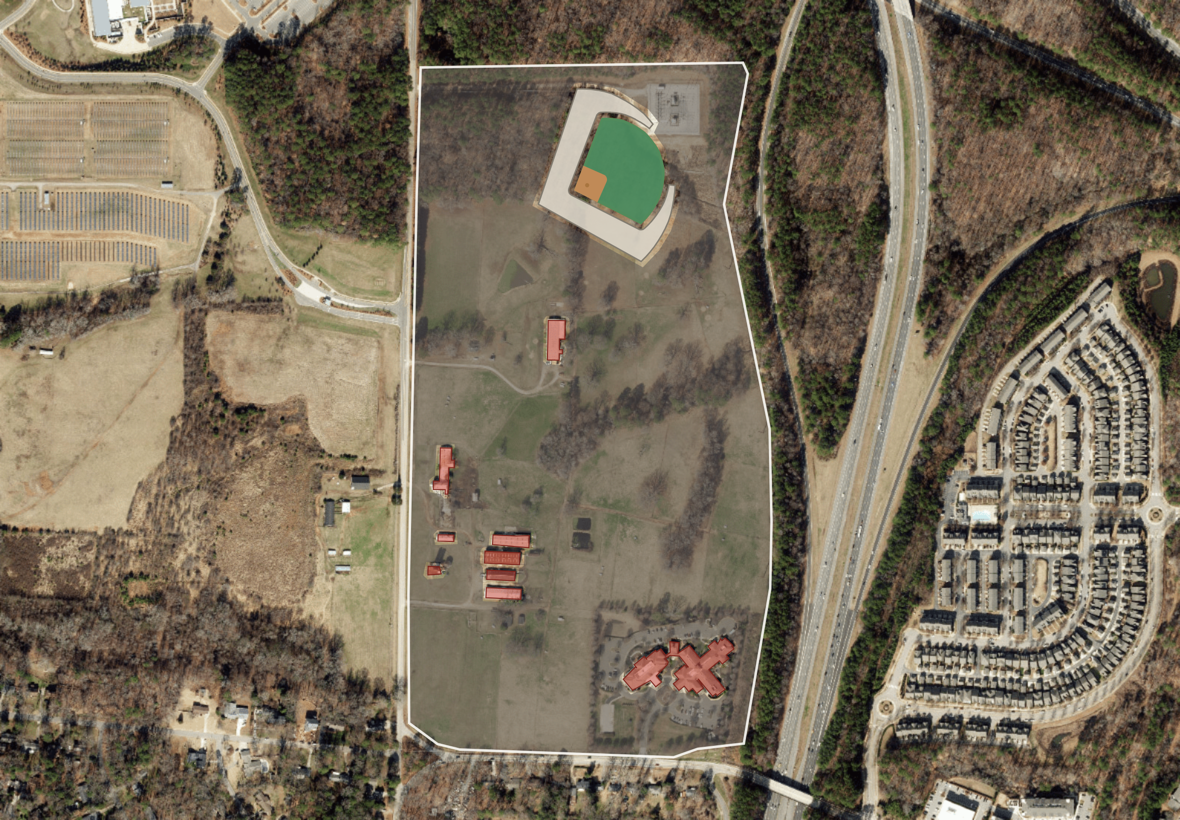
Where the insiders and the algorithm disagree is mostly about cost and shape, and the tool is honest about that tradeoff. Open any site and the score bars show you exactly why it landed where it did.
The Bulls problem, and a baseball state
One thing the tool takes seriously that most hot takes ignore: the Durham Bulls.
North Carolina’s baseball identity is minor league. The Bulls have been around since 1902, got immortalized by the 1988 movie Bull Durham, and have won eight International League titles (Durham Bulls). Drop a big-league team right on top of them and you risk wrecking one of the best things the region already has. So “distance from the Bulls” is an actual scoring axis, nudging the model away from cannibalizing Durham.
And make no mistake, this is baseball country. USA Baseball runs its national training complex in Cary. NC State reached the College World Series in 2024, and both UNC and Wake Forest got there in 2026 (Axios). The talent and the appetite are already here. The thing that is missing is the ballpark.
A few honest disclaimers
This is a data experiment, not a prediction, and definitely not my personal wish list. The rankings are the model’s opinion, not mine, and I am not claiming all eighteen of these sites could realistically get built. Plenty of them never will.
In fact the tool argues with itself about exactly that. It runs a reality check on every finalist, and the most satisfying one is the airport. Using RDU’s actual runway geometry, it throws out any site that sits under a runway approach path, because a stadium with 60-meter light towers cannot legally exist there. A tempting parcel right off the airport looked great on paper and then got disqualified outright. That is the tool working the way it should.
Straight-line distances, coarse land-use codes, and assessed values standing in for real prices mean you should treat the whole thing as directional, not gospel. It is a starting point for an argument, not the end of one.
Anyway, the Canes have their trophy. Maybe baseball is next. Until then, you can pull up the map, pick a site, and argue with the rankings yourself.
Sources
- Major sports investor wants to bring MLB to Raleigh (WRAL)
- NC lawmakers negotiate stadium cash in the budget (WRAL)
- MLB expansion candidate cities (ESPN)
- Council approves the Hurricanes’ Lenovo Center redevelopment (WRAL)
- Lenovo Center (Wikipedia)
- Downtown South (Wikipedia) and where a Raleigh stadium might go (Axios)
- Durham Bulls history (Wikipedia)
- What Tom Dundon said about the Canes and MLB hopes
- NC schools chasing the College World Series (Axios)