Tesla Tunnels Explained: How The Boring Company's Loop Works and Where It Runs
A plain-language guide to The Boring Company's Loop: Teslas driven through small tunnels, how a ride works, how it compares to a subway or hyperloop, and where it runs or is planned.

“Tesla tunnels” is shorthand for the Loop, a system of narrow underground tunnels where ordinary Teslas, driven by trained human drivers, carry passengers from one stop to another. The company behind it, The Boring Company, has its own nickname for the idea: “Teslas in Tunnels!”
Today the only Loop you can ride is in Las Vegas, but the company is building one in Nashville, preparing a pilot in Dubai, and pitching the idea to a handful of other cities. Here’s how it works and where things stand as of October 2026.
You can trace every Loop route in my companion Loop map.
Key takeaways
-
The Loop is cars in tunnels. Regular Teslas with human drivers run through single-lane tunnels about 12 feet across. What it is.
-
Rides go nonstop. You board at a small station and skip every stop in between. How a ride works.
-
It’s a different idea from a hyperloop. Passenger service uses no vacuum tubes, pods or magnetic levitation. How it compares.
-
Las Vegas has the only public system. It started at the convention center and now reaches nearby resorts and, partly on surface streets, the airport. The Vegas Loop today.
-
Nashville is under construction and Dubai is preparing a pilot. Orlando, New Orleans and Dallas are still at the proposal stage. Projects beyond Vegas.
-
Most Loop price tags are company pitches. The convention center Loop, built under a $48.7 million contract, is the main exception, at about $61 million per route-mile. What it costs.
-
Approvals are mostly local and state deals. Las Vegas runs on county and city franchises, Nashville needed a state tunnel permit and lease that the Federal Highway Administration also approved, and federal review applies when a federal agency funds or approves a project in a substantial way. How it gets approved.
What the Loop is
The Boring Company describes Loop as an “all-electric, zero-emissions, high-speed underground public transportation system.” In Las Vegas that means everyday Tesla cars with trained drivers in single-lane tunnels roughly 12 feet in diameter (ProPublica; Review-Journal), plus Cybertrucks since November 2025.
How a Loop ride works
You book a ride, walk to a station (often just a few parking bays), get in a car, and your driver takes you straight to your destination, skipping every station in between (Review-Journal). Rides between convention center halls are free, a trip to Resorts World runs about $5, and the airport costs $12.
Cars move at 35 to 40 mph in the current tunnels, with 60 mph planned for new ones (Review-Journal). The company’s FAQ says Loop vehicles could someday hit 150 mph.
Since October 2025, some rides on one short leg have been self-driving, with a safety driver still behind the wheel (Review-Journal). In June 2026 the head of the Las Vegas tourism authority said there’s “no timeline” for fully driverless rides.
How the Loop differs from a subway or a hyperloop
A subway runs long trains that stop along the line, while a Loop car holds a handful of riders and goes point to point. The company describes it as “an underground highway more than a subway.” Critics say that design caps capacity at a fraction of a subway’s (Wikipedia).
The company says the convention center Loop is designed for 4,400 passengers an hour, while the highest measured figure TechCrunch reported (from the system’s opening through mid-July 2021) was 1,355 passengers an hour.
It’s easy to mix it up with hyperloop, since the company used to pitch something closer to one. Chicago’s 2018 O’Hare plan, a separate and older pitch, promised electric “skates” at up to 150 mph, and the first test tunnel in Hawthorne, California ran cars on guide wheels (Wikipedia). Ordinary cars replaced all of that, and hyperloop survives only as a short test tunnel in Bastrop, Texas (The Boring Company).
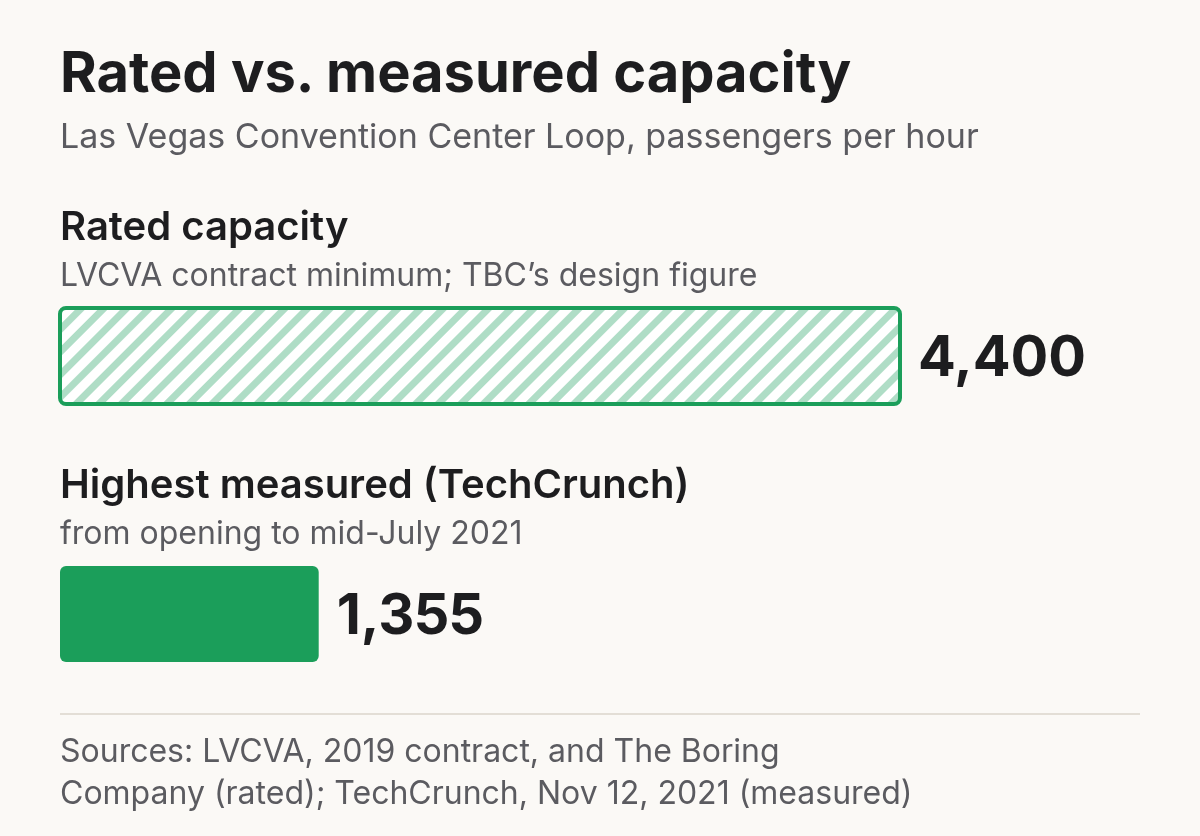
Rated capacity: LVCVA, 2019 contract; also The Boring Company’s stated design figure. Measured peak, opening to mid-July 2021: TechCrunch, Nov 12, 2021.
Where the Loop runs today: Las Vegas
The Vegas Loop began as the LVCC Loop connecting the halls of the Las Vegas Convention Center, and it’s carried about 3.5 million passengers there since 2021, according to the Review-Journal. Tunnels now reach resorts including Resorts World, Westgate, Encore, Fontainebleau and Sahara, and the company counts 14 stations as of October 2026 (other sources count them differently).
Rides to Harry Reid International Airport use up to 4 miles of surface streets, since no tunnel reaches the airport yet. Two boring machines are digging from 4744 Paradise toward a planned station at 5022 Palo Verde Road, near the airport (Review-Journal).
As of late October 2026, the roughly 2-mile twin tunnels under Paradise Road between Westgate and a company-owned site near UNLV are going through permit inspections but aren’t open. The plan is now to open both tunnels at once, with three new stations, before the Las Vegas Grand Prix (November 19 to 21), but there’s no confirmed date (Review-Journal, Oct 22, 2026; FOX5). On paper the plan is far bigger: county approvals cover 68 miles and 123 stations, according to the Review-Journal, though each segment still needs its own building permits.
Where Loop tunnels are being built or planned
Nashville’s Music City Loop would run from downtown to Nashville International Airport (environmental assessment). As of October 2026, two machines are digging and a third is set to launch in late October (The Boring Company), with no official opening date. The company says it’s spending “a few hundred million dollars” of private money.
Dubai’s pilot is a 6.4 km (about 4-mile) route with four stations for roughly US$154 million, and a September 2026 Gulf News report said tunnel-machine assembly and segment casting were under way (Gulf News).
Earlier-stage projects include:
-
Universal Orlando, in contract talks (WESH)
-
New Orleans and Dallas, winners of the 2026 “Tunnel Vision Challenge” (USA Today)
-
Abu Dhabi, under an exploratory agreement (Abu Dhabi Media Office)
-
San Antonio, an accessibility tunnel at Morgan’s Wonderland still awaiting permits (News4SA)
Several past pitches have stalled. Chicago’s O’Hare line lapsed, a Washington to Baltimore Loop is still listed as “paused” on the federal permitting dashboard as of October 2026, and San Antonio’s airport agency says it was “ghosted”.
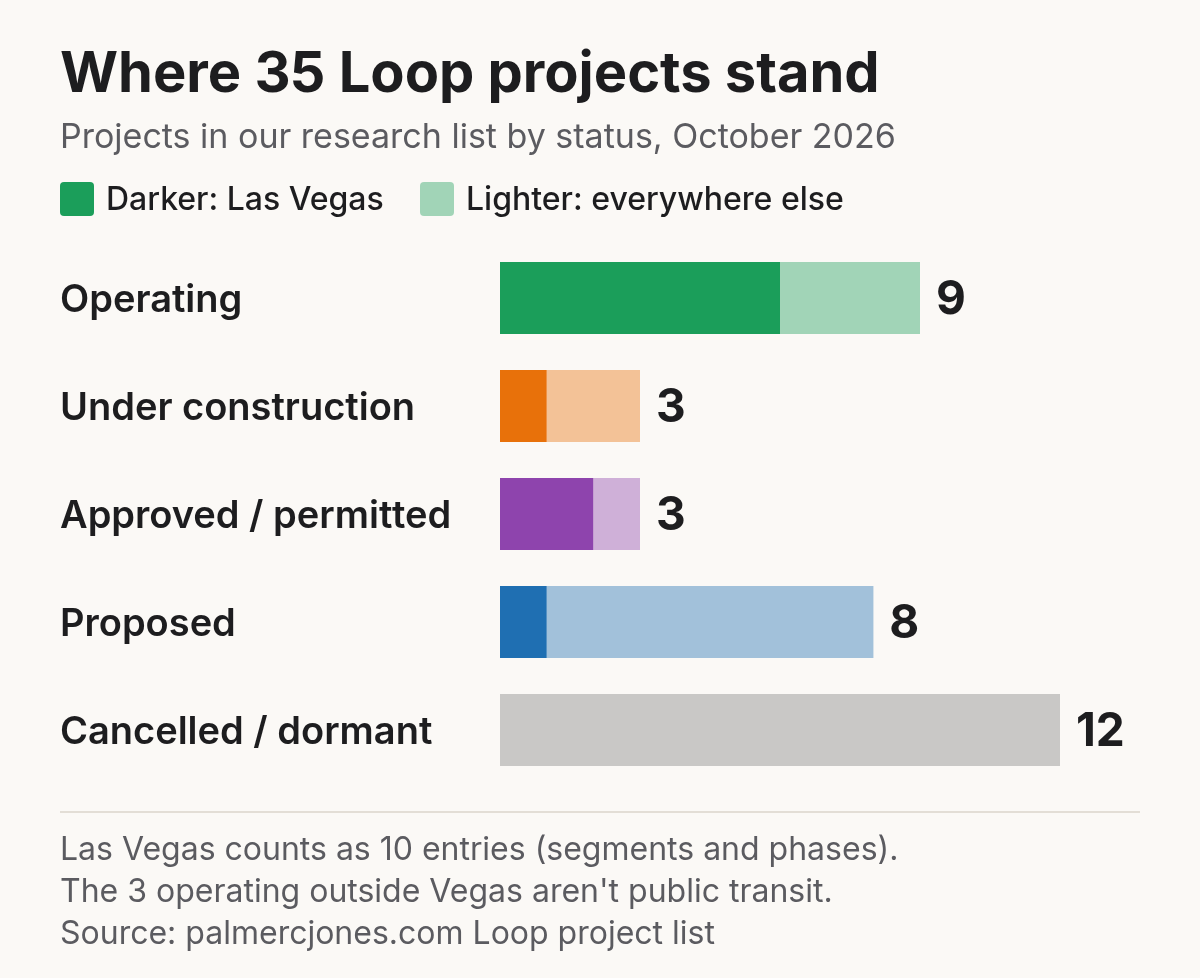
Source: palmercjones.com Loop project list and map, compiled from public records and reporting as of October 2026.
What the Loop costs, and who pays
Most published Loop prices are company pitches or estimates for projects that were never built. The main exception is the convention center Loop. Its $48.7 million contract was approved in 2019 (LVCVA), and the tourism authority’s board signed off on selling bonds to pay for it (Review-Journal).
| Project | Estimated cost | Who pays | Cost per mile | Source |
|---|---|---|---|---|
| LVCC Loop, Las Vegas (operating) | $48.7M (contract, 2019), plus $25M over five years to operate | Public: the Las Vegas tourism authority | about $61M per route-mile | LVCVA; Review-Journal |
| Vegas Loop expansion | Total not disclosed; each station $1.5M to $20M | Private: the company pays for tunnels, property owners for their stations | not disclosed | Review-Journal; Nevada Current |
| Hawthorne test tunnel, California | under $10M, excluding R&D (company figure) | Private: the company | under $8.8M (one tunnel, no stations) | The Boring Company; Wikipedia |
| Music City Loop, Nashville | ”a few hundred million dollars” (company figure) | Private; the state leases land and right-of-way | not disclosed | The Boring Company |
| Dubai Loop pilot | AED 565M, about US$154M (agreement, 2026) | not disclosed | about $39M | Dubai Media Office; The Boring Company |
| O’Hare Express, Chicago (cancelled) | about $1B (planning estimate, never contracted) | Proposed as fully private | about $59M | CMAP; Streetsblog |
| San Antonio airport to downtown (dormant) | $247M to $289M (company pitch, 2022) | Proposed: revenue bonds, with a company financing option | about $27M to $32M | San Antonio Report |
| Ontario Airport Loop, company version | $45M to $60M (company pitch, 2020) | Public: the county transportation agency | about $16M to $21M | SBCTA |
| Ontario airport tunnel, agency version (cancelled) | $492M (agency plan, 2022); bids of $1.28B and $2.46B (press reports) | Public: local, state and federal money | about $117M (2022 plan) | SBCTA fact sheet; Excelsior California |
That $61 million figure is per route-mile, using the roughly 0.8 miles of route in each direction that the original Loop had as built in 2021, before it was later expanded (LVCVA). If you count each one-way tunnel separately (tunnel-miles, about 1.7 miles in all in the original system, per The Boring Company), the figure roughly halves, to about $29 million a mile.
US rail lines that run mostly at street level average about $117 million a mile, while subways run from about $570 million a mile (the US average for mostly tunneled lines) to about $2.47 billion a mile for New York’s Second Avenue Subway (Eno Center for Transportation; AECOM). That comparison isn’t like-for-like, because Loop tunnels are small, single-lane bores for cars and carry far fewer people per hour than a rail line.
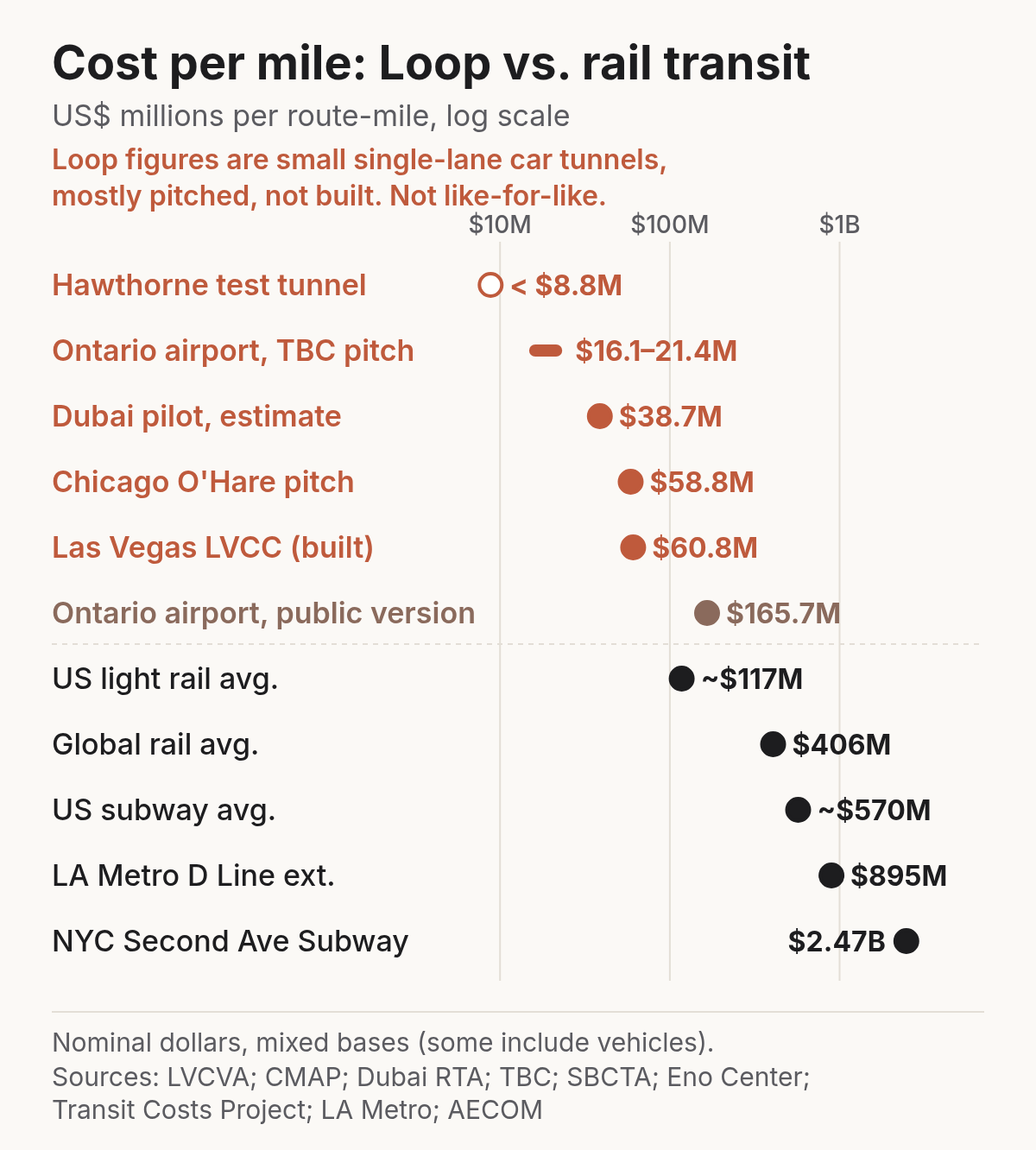
Not like-for-like: Loop figures are single-lane car tunnels, mostly pitches. Nominal dollars, mixed bases. Sources: LVCVA, CMAP, SBCTA, Dubai RTA, Eno Center, Transit Costs Project, LA Metro, AECOM.
How a Loop gets approved
In Las Vegas, the first step was a land deal. In 2021 Clark County gave the company a 50-year franchise (to 2071) to build and run the Loop under county roads, with the company paying for all permits and property rights and giving the county a share of fare revenue (Clark County). The City of Las Vegas approved its own 50-year agreement in 2022. Each station then needs its own land-use approval, and the property owner pays to build it, at $1.5 million to $20 million depending on size (Review-Journal). In May 2026 the county added fire rules written for single-lane tunnels, covering ventilation, fire suppression, exit spacing and specialized fire-response vehicles (Review-Journal).
Nashville’s route runs under state roads, so the key approval was a TDOT (Tennessee Department of Transportation) tunnel permit and right-of-way lease, approved jointly by TDOT and the Federal Highway Administration (FHWA) in February 2026 (Tennessee governor’s office). What level of federal environmental review FHWA applied hasn’t been made public. The airport authority approved a 50-year license for a station at Nashville International Airport, at no cost to the airport (Nashville International Airport).
Federal environmental review under the National Environmental Policy Act (NEPA) applies when a federal agency funds or approves a project in a substantial way (42 U.S.C. 4336e). ProPublica reported that the Vegas Loop, which takes no federal money, is exempt from many of those requirements (ProPublica). The Washington to Baltimore Loop was proposed to run beneath the Baltimore-Washington Parkway (Federal Register), so it got a draft federal environmental assessment in 2019 (US DOT), and the federal permitting dashboard still lists that review as paused as of October 2026.
Dubai’s process runs through one government client: the Roads and Transport Authority, which signed a definitive agreement for the pilot in February 2026 (Dubai Media Office).
Cost can stop a project too, as it did with the airport tunnel in Ontario, California. After the company stepped away in 2022, the local transportation agency’s own version grew from a $492 million plan to bids that press reports put at $1.28 billion and $2.46 billion. The agency’s board cancelled it in December 2025 as “well beyond” budget (SBCTA; Excelsior California).
Safety violations, fines and environmental concerns
In 2023 Nevada OSHA issued eight “serious” citations totaling about $112,500 (made public in February 2024), covering chemical burns, flooding and unguarded conveyors at the Vegas worksite. The Boring Company contested them, and they were still pending as of February 2026.
Fortune reported that two Clark County firefighters suffered chemical burns in a training drill. According to the same report, Nevada OSHA issued about $425,000 in “willful” citations in May 2025, the company’s president called the governor’s office that same day, and by the time a meeting with state officials started the next afternoon, the citations had been withdrawn (Fortune). Nevada OSHA says nothing said at that meeting was the basis for the withdrawal.
ProPublica reported that state environmental regulators alleged nearly 800 violations, including untreated water discharged onto streets, and sought $242,800, against a possible penalty of more than $3 million (ProPublica). The county water district separately fined the company about $493,000 for dumping drilling fluid into sewers.
In Nashville, a Southern Environmental Law Center report warns that the area’s karst limestone could lead to sinkholes or water inflows, and that the route passes near nine contaminated sites (Tennessean). The Boring Company’s environmental assessment found “no meaningful impacts,” and the company says its tunnels have emergency exits, ventilation, fire suppression and full camera coverage (The Boring Company).
What the Loop delivers today, and what to watch next
Today the Loop is a 14-station system in Las Vegas, with Teslas carrying riders between the convention center, nearby resorts and the airport (The Boring Company). The promises run well ahead of that. The convention center Loop was designed for 4,400 passengers an hour, against a highest measured figure of 1,355 (TechCrunch). County approvals cover 68 miles and 123 stations (Review-Journal), and fully driverless rides still have “no timeline”.
The first test is the Paradise Road tunnels toward UNLV, which are in permit inspections and aiming to open together before the Las Vegas Grand Prix (November 19 to 21), with no confirmed date (Review-Journal; FOX5). In Nashville, a third tunneling machine is set to launch in late October (The Boring Company). Dubai was assembling machines and casting tunnel segments for its pilot as of September (Gulf News).
Pull up the companion Loop map and tell me which stop you’d ride to first.
Frequently asked questions
Is The Boring Company’s Loop a hyperloop?
No. The Loop runs ordinary Teslas, driven by trained drivers, through small single-lane tunnels (The Boring Company). The company’s only hyperloop work is a short test tunnel in Bastrop, Texas (The Boring Company).
How much does a Vegas Loop ride cost?
Rides between Las Vegas Convention Center halls are free (Review-Journal). A trip from the convention center to Resorts World costs about $5, and a ride to Harry Reid International Airport costs $12.
How fast does the Vegas Loop go?
Cars travel at 35 to 40 mph in the existing tunnels, and the company plans 60 mph in new ones (Review-Journal). The Boring Company says Loop vehicles could someday reach 150 mph.
Is the Vegas Loop safe?
The Boring Company says its tunnels have emergency exits, ventilation, fire suppression and full camera coverage (The Boring Company), and Clark County adopted fire rules for single-lane tunnels in May 2026 (Review-Journal). Worker safety has a rougher record: Nevada OSHA issued eight “serious” citations at the Vegas worksite in 2023, which the company was still contesting as of February 2026 (KSNV; KTNV).
Do the Tesla tunnels drive themselves?
Some rides on one short leg have been self-driving since October 2025, with a safety driver still behind the wheel (Review-Journal). The head of the Las Vegas tourism authority said in June 2026 there’s “no timeline” for fully driverless rides (Review-Journal).
Who pays for the Boring Company Loop?
The Las Vegas tourism authority paid for the original convention center Loop under a $48.7 million contract approved in 2019. For the wider Vegas Loop, the company pays for the tunnels and property owners pay $1.5 million to $20 million for their own stations (Review-Journal). The company says Nashville’s Music City Loop is privately funded at “a few hundred million dollars”.
Where can I ride the Tesla tunnels?
As of October 2026, only in Las Vegas, where the Vegas Loop serves 14 stations including the convention center, Resorts World, Encore, Fontainebleau and Harry Reid International Airport (The Boring Company). Airport rides drop off at the Terminal 1 and Terminal 3 Departures curbs and pick up on Level Zero (Harry Reid International Airport), using up to 4 miles of surface streets. A Nashville line is under construction and Dubai is preparing a pilot (The Boring Company; Gulf News).
Sources
-
Las Vegas Review-Journal: Tourism agency to spend $25M to run Vegas Loop (June 2026)
-
Las Vegas Review-Journal: Vegas Loop expansion weeks away (September 2026)
-
Las Vegas Review-Journal: Vegas Loop begins Reid airport rides (December 2025)
-
Las Vegas Review-Journal: Vegas Loop’s future build detailed (February 2026)
-
Las Vegas Review-Journal: Riding a self-driving Tesla through the Loop (November 2025)
-
Las Vegas Review-Journal: 19 more stations approved, total 123 (August 2026)
-
FOX5 Las Vegas: Will new Vegas Loop stop near UNLV open ahead of F1? (October 2026)
-
Harry Reid International Airport: Vegas Loop (accessed October 2026)
-
Music City Loop Environmental Impact Assessment (December 2025)
-
Abu Dhabi Media Office: ADPIC and The Boring Company partnership (October 2026)
-
News4SA: Tunnel machine arrives at Morgan’s Wonderland (October 2026)
-
Federal Permitting Dashboard: Washington DC to Baltimore Loop
-
KSNV News 3: Nevada OSHA finds multiple safety violations at Boring Company worksite
-
Fortune: Boring Company OSHA citations rescinded (November 2025)
-
Tennessean: Nashville tunnel risks to water, sinkholes and contamination (October 2026)
-
LVCVA: Las Vegas moves forward with first underground people mover (May 2019)
-
Las Vegas Review-Journal: LVCVA approves nearly $50M contract for underground transit system (2019)
-
LVCVA: Las Vegas one step closer to reducing traffic congestion (2021)
-
Las Vegas Review-Journal: Underground Loop approved for Strip-downtown connection (2022)
-
Nevada Current: Boring Co. wants Vegas Loop expansion (July 2023)
-
Las Vegas Review-Journal: Vegas Loop expansion and the county’s new ordinance (May 2026)
-
Dubai Media Office: RTA signs agreement with The Boring Company (February 2026)
-
San Antonio Report: Alamo Loop tunnel proposal will get further study (March 2022)
-
SBCTA: Collaborating to develop tunnel connecting ONT to Metrolink (2020)
-
Excelsior California (Southern California News Group): Ontario airport tunnel cost (December 2025)
-
Eno Center for Transportation: Transit construction cost database
-
LA Metro: D Line Extension Section 1 status report (June 2026)
-
Tennessee Governor’s Office: Lease and permit approved for The Boring Company (February 2026)
-
Nashville International Airport: MNAA approves license agreement with TBC (February 2026)
-
US DOT: Draft environmental assessment for proposed Loop tunnel (2019)
-
Federal Register: Environmental assessment for the Washington DC to Baltimore Loop (April 2019)