Bring Back the RDU–XNA Nonstop
Northwest Arkansas Regional is offering $30,000 a week to any carrier that launches nonstop service to Raleigh. The route existed until 2009, and the DOT data still supports it.
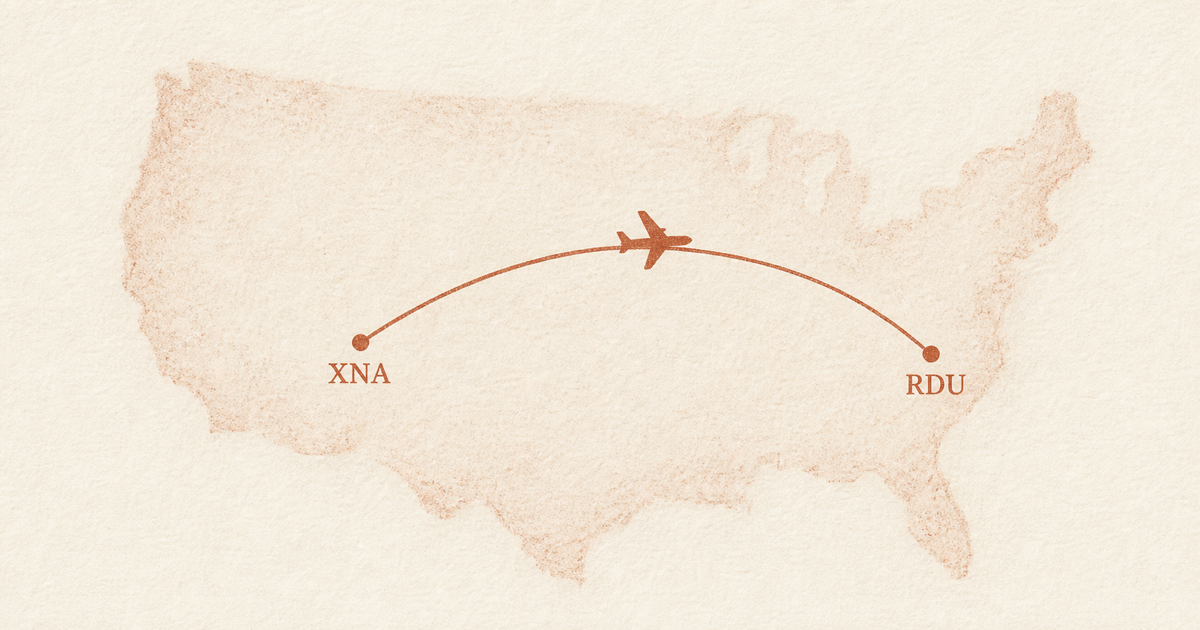
In March 2026, the Northwest Arkansas National Airport Authority approved a new incentive program naming nine unserved markets they want a carrier to fly nonstop. Raleigh is on it. The package for whoever launches the route: $30,000 per weekly operating day in Year 1, $15,000 in Year 2, plus 18 months of landing-fee waivers.
As a frequent traveler out of RDU with family in Northwest Arkansas, I fly the 1-stop version of this trip several times a year (usually RDU to CLT to XNA on American). The route existed nonstop as recently as 2009, XNA is actively paying to get it back, and the DOT data still lines up.
The route already existed
American Eagle flew RDU–XNA nonstop from November 2007 through 2009 with 37-seat ERJ-135 jets. The 2007 launch was pitched around business travelers heading to Bentonville.
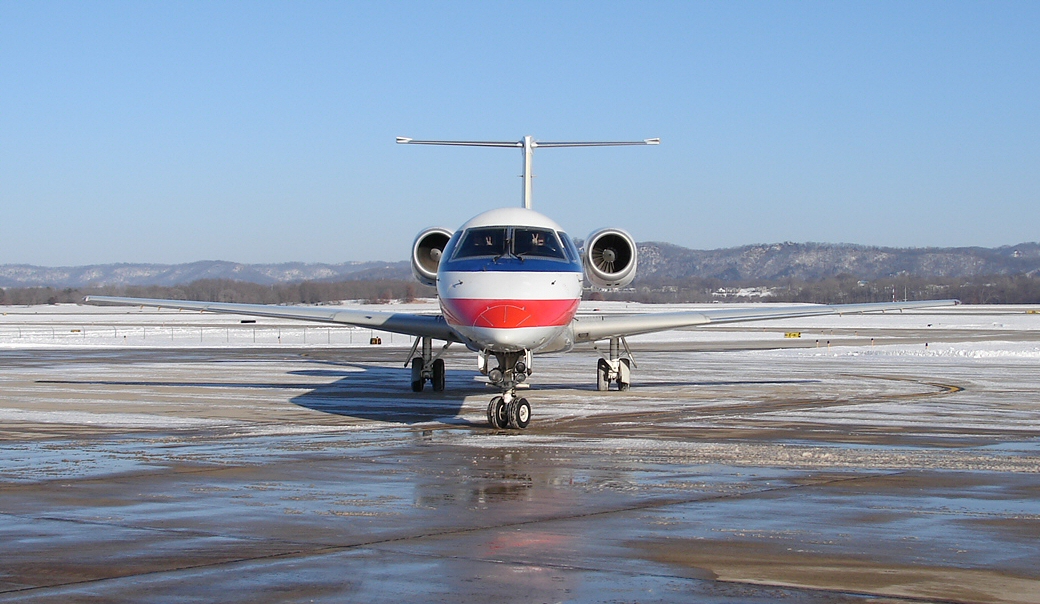 Photo: Cory W. Watts via Wikimedia Commons, CC BY-SA 2.0.
_(3160256823).jpg)
Two things happened after 2008 that killed a lot of routes like this. Jet fuel prices roughly doubled between early 2007 and mid-2008, and the small regional jets that made thin markets work (the ERJ-135s and 50-seat CRJs) went from marginal to actively money-losing. American, Delta, and United all parked hundreds of them between 2008 and 2012. RDU–XNA got caught in that fleet shift, along with a long list of similarly thin markets.
The equipment story is different now. Breeze flies A220s and E195s. Regional partners have moved to 65- and 76-seat E175s. Neither is a perfect fit for a 40-passenger-a-day market on day one, but both make much more sense than a 37-seat ERJ ever did.
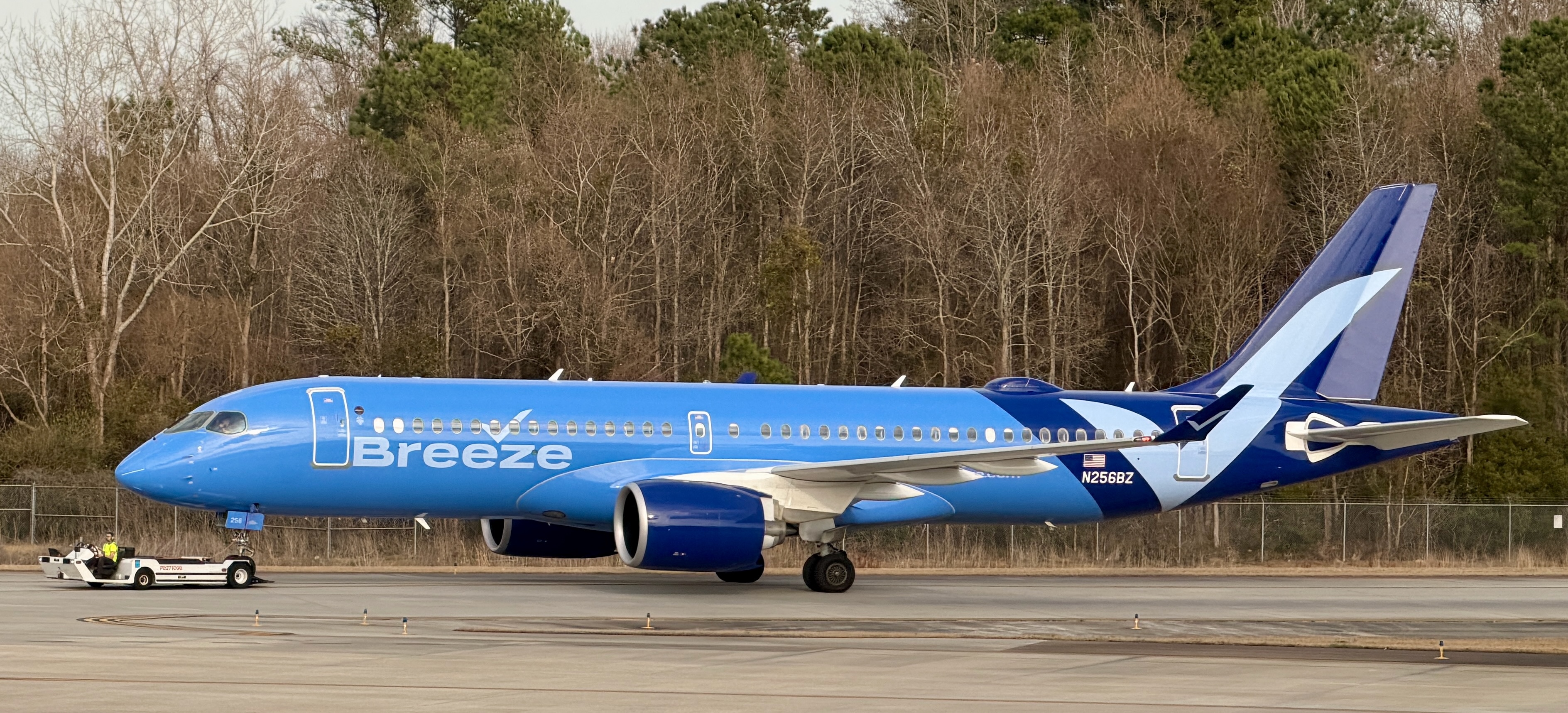 Photo: Oleg Yunakov via Wikimedia Commons, CC BY-SA 4.0.

XNA wants Raleigh
XNA’s Board explicitly tiered nine unserved markets in March 2026. Raleigh is a Tier 2 target with 26 passengers per day estimated from XNA’s own catchment analysis. Tier 2 unlocks the full incentive package above.
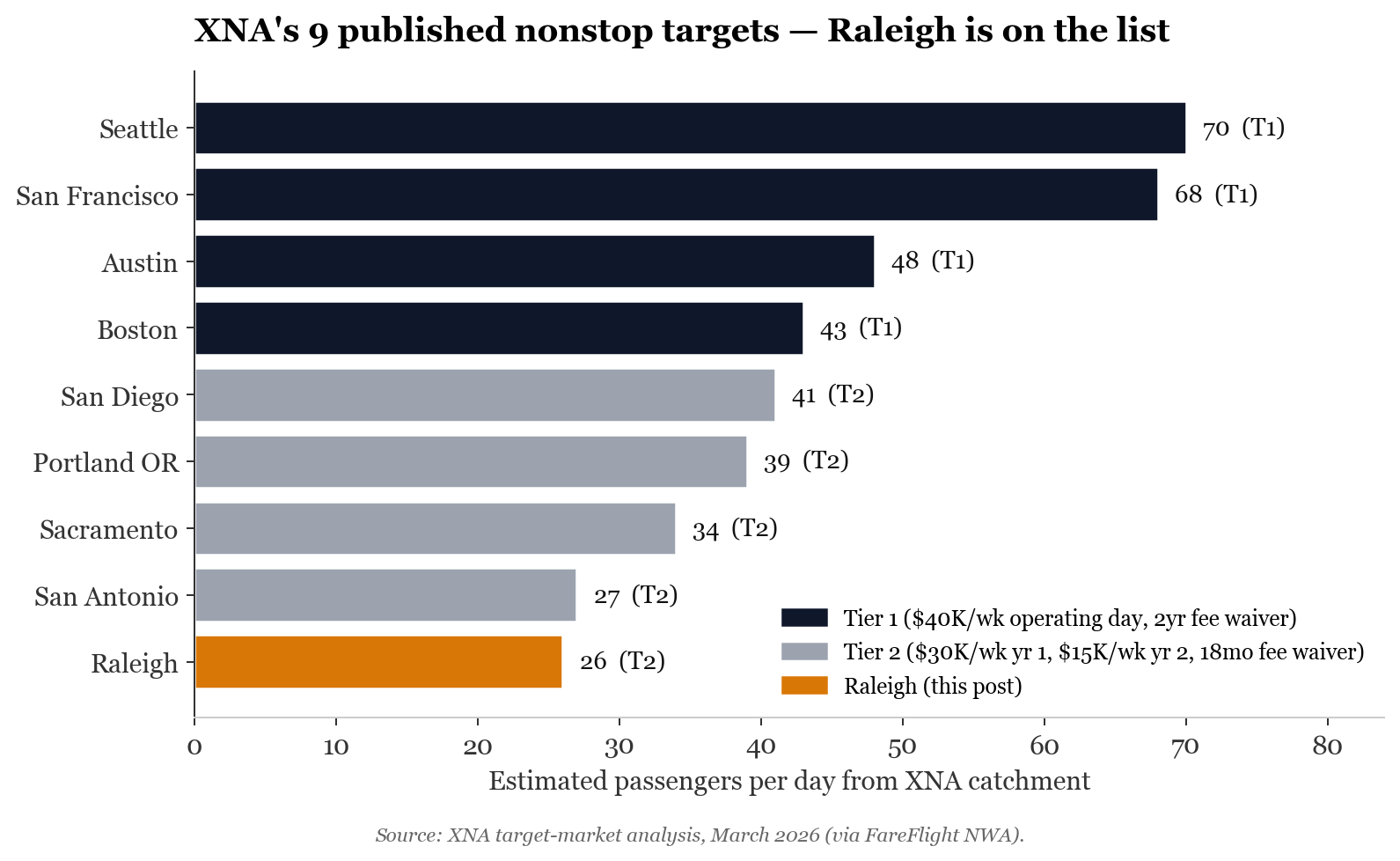
That’s about as clear a public signal as an airport authority ever sends. A published dollar figure, tied to a specific city pair, still on the table.
47 people a day, all connecting
I pulled the DOT’s 2025 H1 DB1B Market data to see what actually moves between the two cities today. The DB1B is a 10% ticket sample the DOT publishes every quarter for every US city pair, so the numbers are directional but real.
Extrapolated out, about 8,600 passengers flew between the two cities in the first half of 2025 (both directions combined), or roughly 47 per day, at an average one-way fare of $243. Virtually all of them route through the same four hubs:
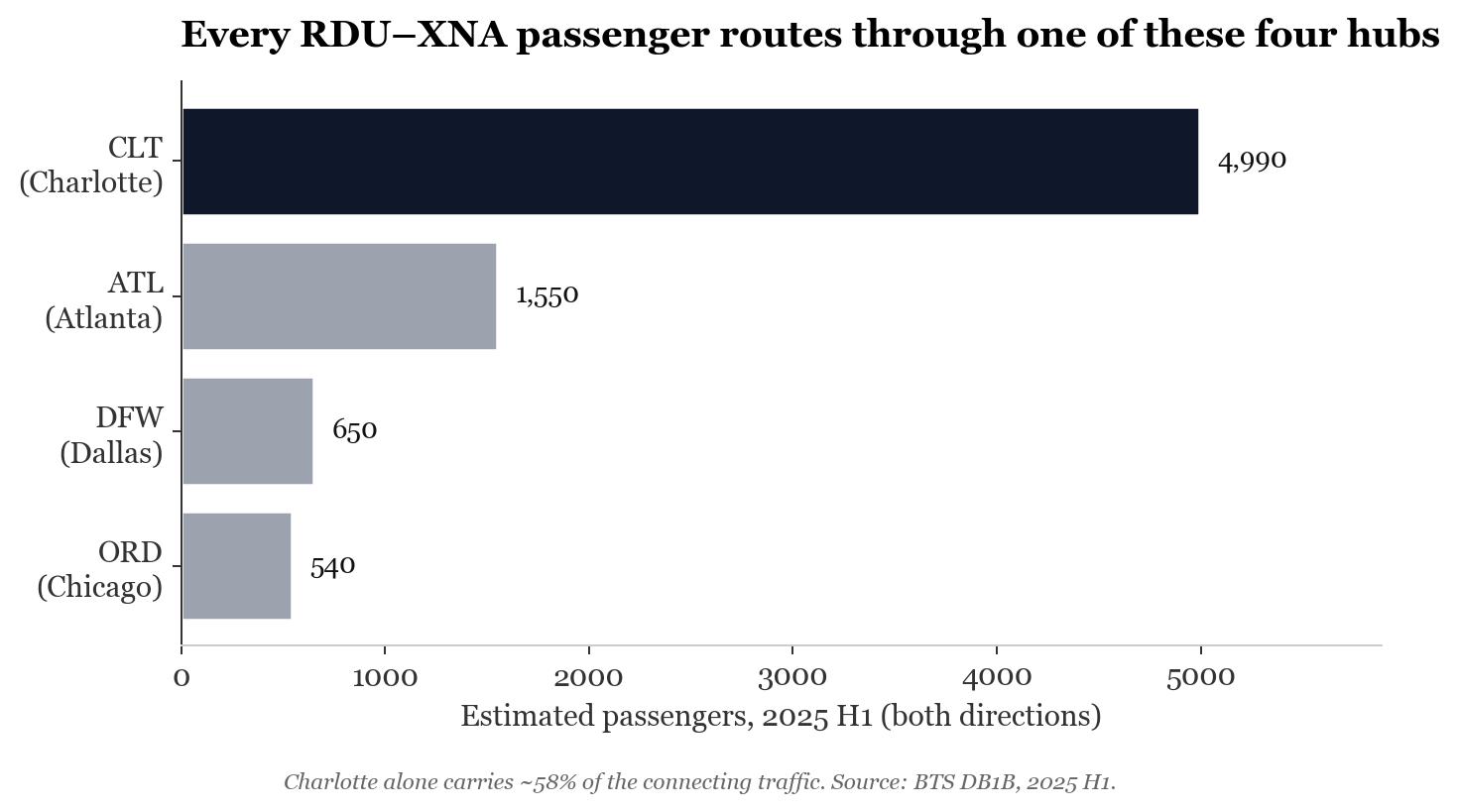
Because those hubs are each tied to one carrier (CLT and DFW to American, ATL to Delta, ORD to United), the market-share picture falls out directly:
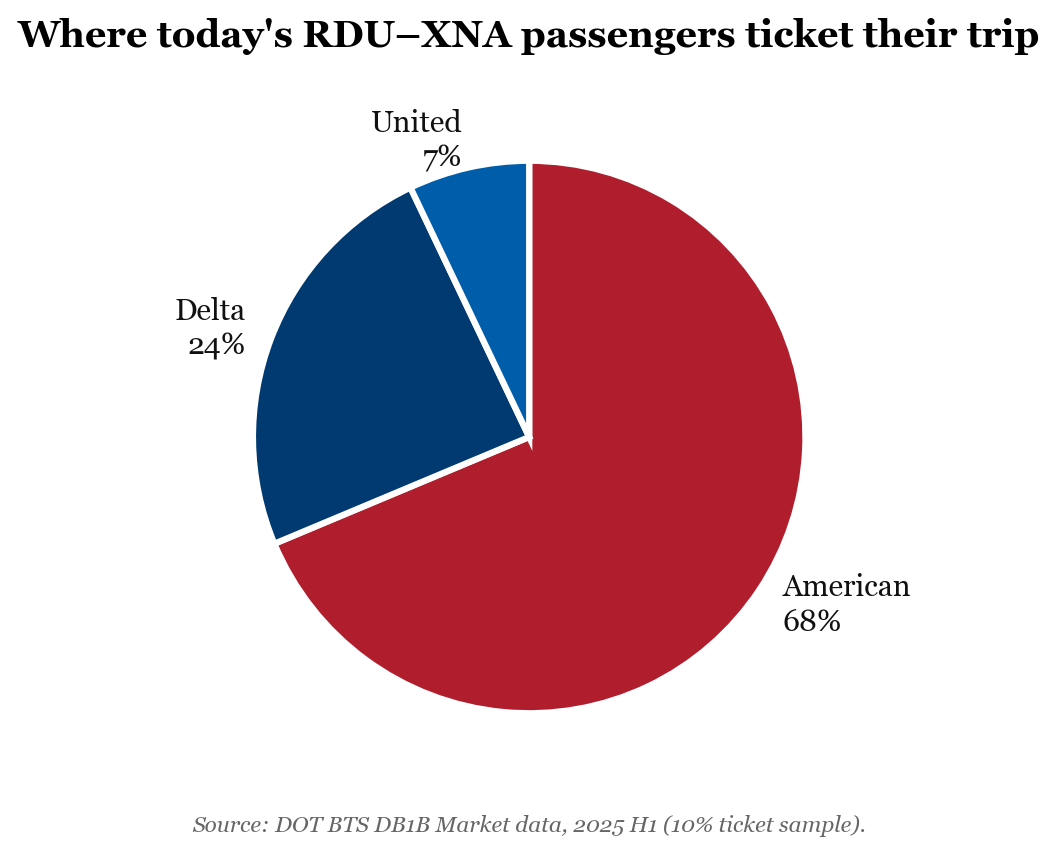
American isn’t being asked to invent demand here; they’re already carrying two-thirds of it via CLT.
Bentonville isn’t small anymore
The Triangle-specific corporate case is dense. The RTP tech footprint (SAS, Cisco, Red Hat, IBM, Fidelity, Lenovo, Epic Games) has active supplier and partner relationships in Bentonville and Fayetteville. Duke, UNC, and NC State all have research and athletic ties to the University of Arkansas. And Bentonville’s own supplier ecosystem grew from 48 companies in 1994 to over 1,600 by 2018, a real chunk of which is Triangle-based enterprise software and analytics companies with Walmart as a customer.
For those relationships, the current trip is a full-day 1-stop. That’s exactly the kind of friction that suppresses trip frequency without ever showing up in a DB1B count.
Induced demand
The stat that airline route planners consistently under-price is induced demand: the passengers who don’t fly today because the trip is too painful, but who will fly if it’s nonstop.
XNA has a clean recent case study of this. Delta launched XNA–SLC nonstop in early 2025. The market went from 29 passengers per day pre-launch to 49 after (FareFlight NWA analysis).
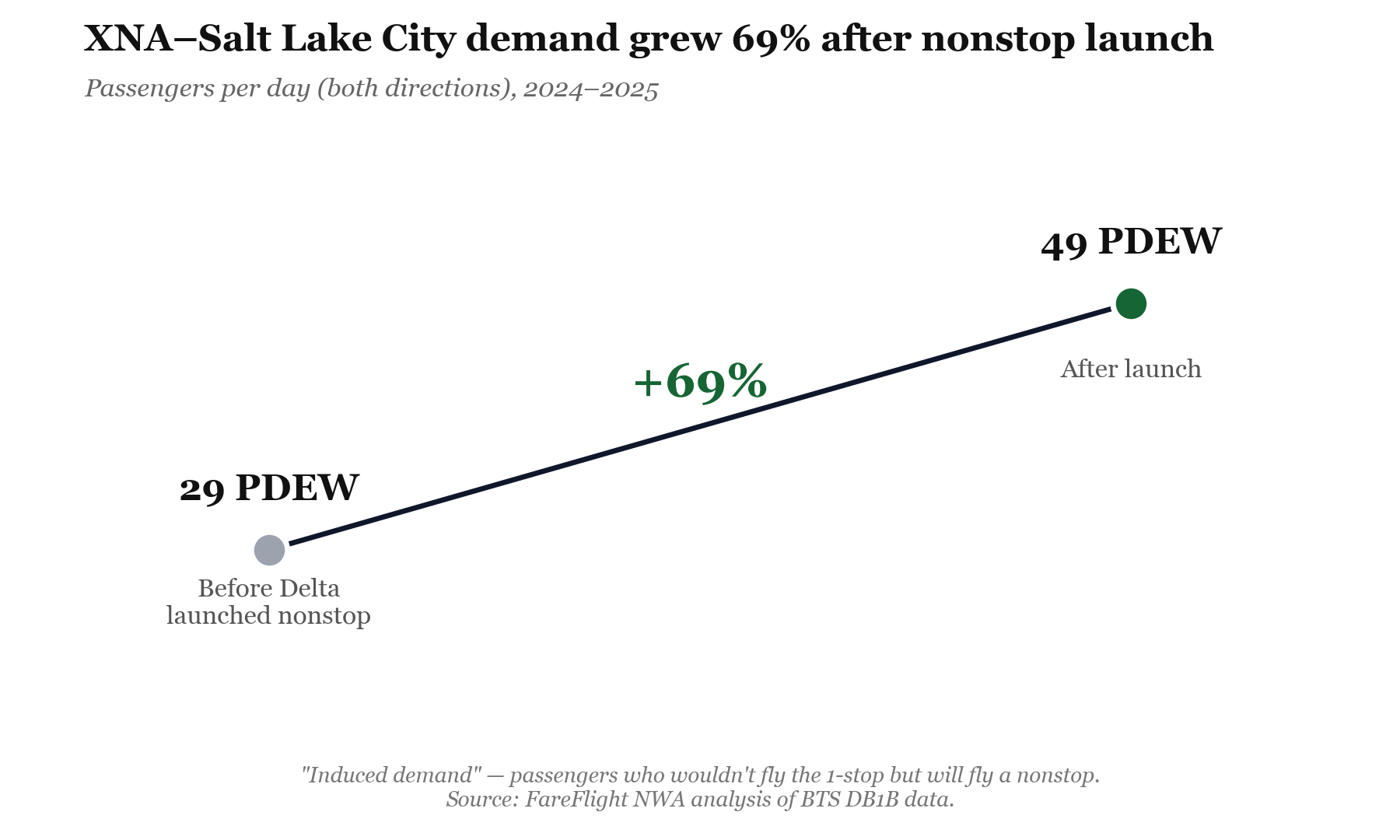
That’s a real lift, not sampling noise: the market grew by two-thirds because the trip stopped being annoying. Apply anything close to that to today’s 47 passengers-per-day (PDEW, in industry shorthand) on RDU–XNA and the market lands somewhere in the 70 to 80 range. That’s daily E175 territory for American, or 3-to-4x-weekly A220 territory for Breeze.
The onward-connection angle
RDU isn’t a hub, but it has grown into a legitimate onward-connection option for Europe and the Caribbean. RDU now serves 80 nonstop destinations across 19 airlines, including 15 international cities:
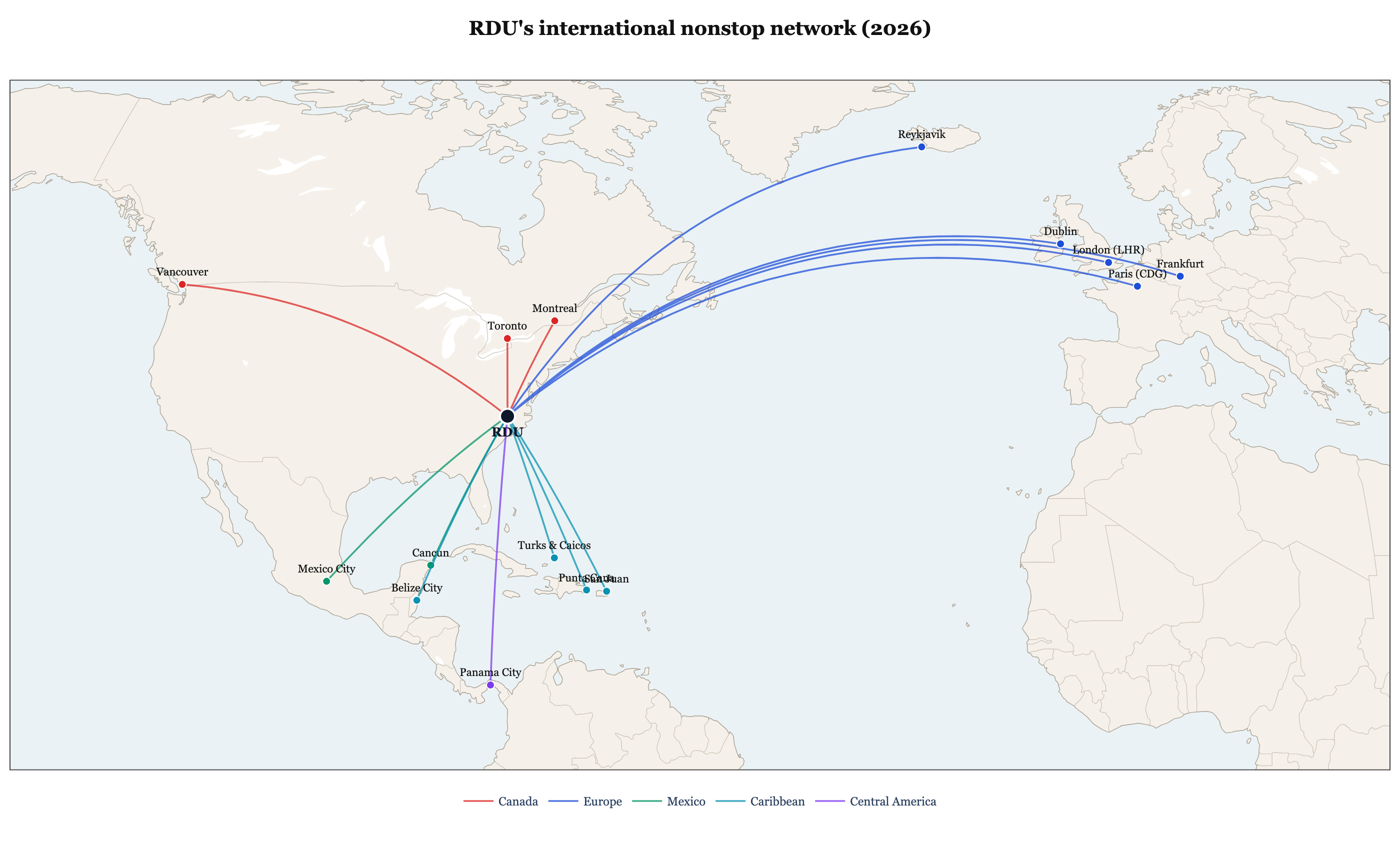
For a passenger flying out of XNA to Europe today, the options are all congested legacy hubs (ATL, DFW, ORD, IAH). An RDU connection would be a legitimately better experience for a chunk of those travelers, and it would give American another feed for its RDU international partners. It’s a secondary argument, not the main one, but it’s real.
Who’s best positioned to fly it
Breeze is the most natural fit. Two reasons. First, they already serve 43 nonstop destinations from RDU, which is more than any other carrier at the airport (Delta is second at 28, American fourth at 19). Their whole model is built around thin point-to-point markets that legacies won’t touch, and this is exactly one of those. Second, Breeze routinely operates markets on a 2-to-4x-weekly basis rather than daily, which is exactly the frequency profile a 47-PDEW market can support without over-supplying it on day one. XNA’s Tier 2 incentive package is the kind of runway that makes a marginal Breeze route pencil out. Dare I say it’s a breeze?
American is the plausible second. They flew it before, they still carry two-thirds of the connecting traffic today, and they have the corporate account depth to hold onto RTP-Bentonville business travel. If AA doesn’t fly it and Breeze does, that revenue walks. If AA flies it themselves, they keep it and cannibalize a portion of their own CLT connections instead.
Delta and United are longer shots. Both are adding XNA capacity, but neither has a natural hub reason to prioritize RDU over adding frequency to their own existing network.
How to help
I built a small interactive tool where anyone who’d fly this route can add themselves to a public count (zip code, how often you’d fly, and why). No email required.
That count is the number I share directly with airport authorities and airline route planners. Direct outreach to the people who actually make these decisions is also more useful than most people realize:
- Andrew Branch, COO / Business Development at XNA: andrew.branch@flyxna.com
- David Freedman, Senior VP & Chief Revenue Officer at RDU, who runs air service development (RDU leadership page)
If you’d fly this route, or you work at an RTP company with real Bentonville travel, sharing this post or replying to it on LinkedIn or X also helps put the market on their radar.
FAQ
Was there ever a nonstop between RDU and XNA? Yes. American Eagle flew it with 37-seat ERJ-135 jets from November 2007 through 2009. The service was launched targeting business travelers heading to Bentonville and was one of many small-jet routes discontinued in the industry’s post-2008 shift away from 37- and 50-seat regional aircraft.
Why did it go away? There’s no single public statement, but the timing lines up with an industry-wide problem: fuel prices doubled between 2007 and 2008, and the small regional jets that made thin markets like this one work became structurally unprofitable. American, Delta, and United collectively parked hundreds of ERJ-135s and 50-seat CRJs over the next several years. RDU–XNA got parked alongside dozens of similar routes as the fleet economics shifted underneath it.
Isn’t Northwest Arkansas too small for this? The Fayetteville-Springdale-Rogers MSA is around 590,000 people and one of the fastest-growing metros in the country. XNA is currently pursuing new routes to Newark, Seattle, San Francisco, Boston, and Austin. This isn’t a hypothetical wish list, it’s a working target-market program with published incentive dollars.
Which airline is most likely to actually do this? Breeze, in my read. They have the most nonstop destinations of any airline at RDU (43, vs. Delta’s 28 and American’s 19), the right equipment (A220), and a business model built for thin, sub-daily point-to-point markets. American is the plausible second: they flew it before, still carry ~68% of today’s connecting traffic, and have the corporate account depth to hold onto RTP-Bentonville business.
Is Charlotte’s existing XNA nonstop a substitute? Only for people who live near Charlotte. For a passenger in Raleigh or the Triangle, connecting through CLT means an out-and-back drive to another airport or a 30-minute regional flight to CLT and then the transcon to XNA. The trip winds up at 5.5+ hours door-to-door versus a hypothetical ~2.5 hour nonstop.
How reliable are the demand numbers? The 47 passengers-per-day figure comes from the DOT’s DB1B market data, a 10% ticket sample the DOT publishes for every US city pair. It’s directional evidence, not airline-grade demand data. Airlines use paid tools (Cirium, Diio) with more granular corporate-contract and unmanaged-demand visibility.
Sources
- RDU press release: American Eagle Announces Nonstop Service to Northwest Arkansas (2007)
- American Airlines press release: American Eagle Continues Growth in Northwest Arkansas (2007)
- FareFlight NWA: XNA offers new incentives for nine priority markets (March 2026)
- FareFlight NWA: Federal data shows strong demand for new XNA nonstop routes
- DOT BTS DB1B Market data, 2025 Q1 and Q2
- Walmart: North Carolina location facts (FY2025)
- Talk Business: Walmart supplier growth in Northwest Arkansas (2018)
- Talk Business: XNA adds Delta service to DTW and SLC (2024)
- RDU: 80 nonstop destinations milestone (July 2025)
- RDU airline destinations page (accessed 2026-07-23): rdu.com/airline-information/airline-destinations
- US Census Bureau: Fayetteville-Springdale-Rogers MSA QuickFacts
- US EIA: Jet fuel spot prices (Gulf Coast)
- Breeze Airways: Our Planes