I Priced One Month of My AI Subscription at API Rates
My $200 Claude Max plan did $1,086 of work in July at Anthropic's published API prices. Subscriptions are the cheap way to buy frontier AI right now, and that window won’t last forever.

I paid $200 for Claude Max 20x in July, which would’ve been $1,086 at Anthropic’s published API rates. That’s 5.4x the usage.
That gap won’t last. Right now a flat monthly subscription is the cheapest way to buy top-tier AI, well under what the same work costs if you pay for the tokens directly, because the AI companies are still competing for users instead of charging them for what they use. Here’s one month of evidence for what that’s worth, and how I think it ends.
Key takeaways
- If you use AI most days, the subscription is the cheap way to buy it. One ordinary month of my work came to $1,086 at published prices against the $200 I paid (the month, priced out).
- The heaviest users are further underwater, which is why this can’t hold. The power users who’ve published their numbers land at 40x to 70x, and somebody is covering that difference (where everyone lands).
- I expect meters, not price hikes. Google has already bolted pay-as-you-go credits onto Gemini, and the price of AI keeps falling underneath all of it (how this window closes).
Hypothetical API pricing for one month
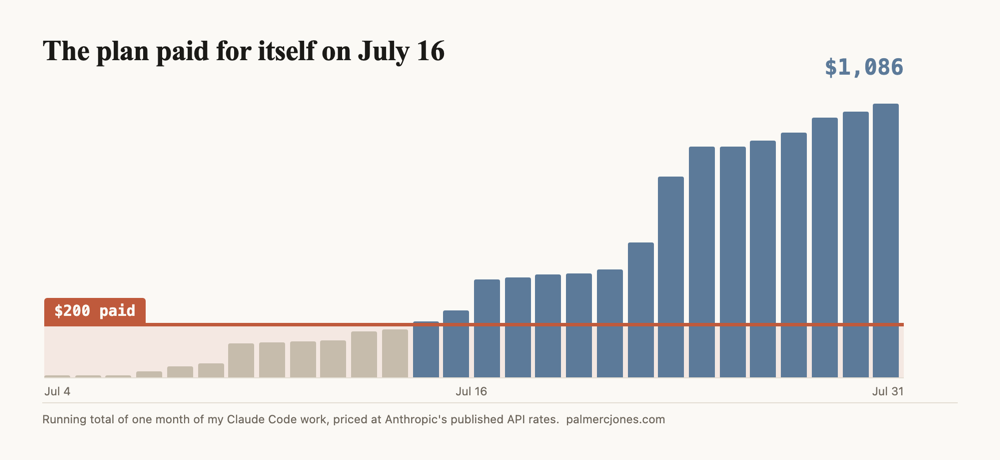
Claude Code saves a transcript of every session, and every reply inside it records how many tokens went in and out. I parsed 309 of those off my Mac mini, threw out the duplicate replies (transcripts replay their own history, so counting straight double-counts), and applied Anthropic’s published prices.
July 2026 is my only complete month, and it was ordinary work: building tools for this site, wiring up home automation, writing data pipelines. It came to 1.23 billion tokens.
Spread across 28 active days, that’s $38.78 per active day. The running total passed the $200 I paid on July 16, so about five average days covers a whole month’s subscription.
On July 24 alone I ran 218 million tokens worth $260.47. One Friday would’ve cost more than the entire month’s subscription.
That total depends on which models I happened to use, so I priced the same month again at the cheapest top-tier model available. Even then it’s $405, or 2.0x what I paid. That’s my floor, and the floor still favors the plan (the much louder numbers people post tend to price their tokens less carefully).
Where I land against everyone else
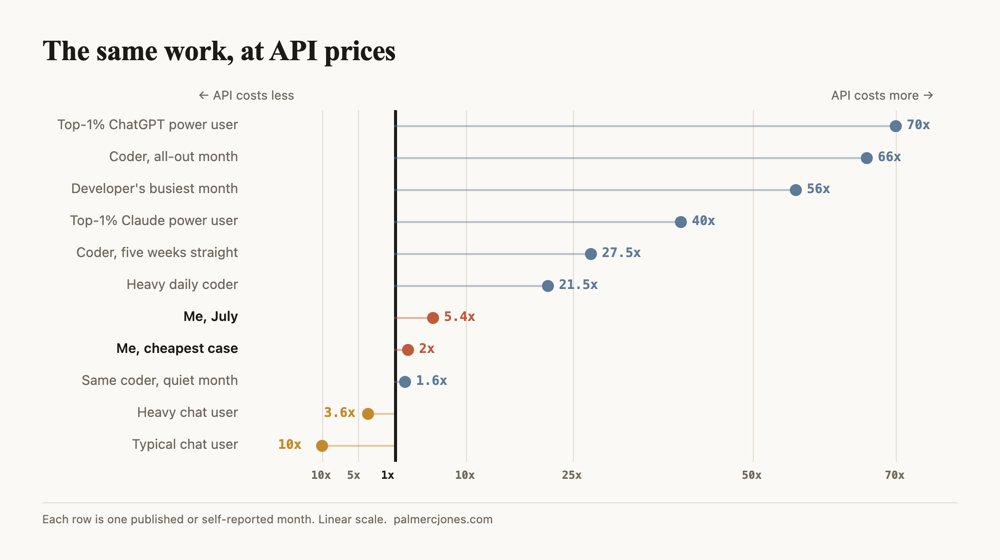
The black line at 1x is parity, where paying per token would cost exactly what the plan costs. Every row is one real month somebody measured and published. The scale is linear on purpose, because log scales make 70x and 5x look like neighbors.
Rows to the right are people the API would charge more than their plan, sometimes far more. Rows to the left would pay less on the API, so their number is how much they’re overpaying. Two rows are mine: 5.4x for July, and 2.0x for that same month under the cheapest assumptions I could justify.
The top of the chart belongs to top-1% users whose plans were bought and run to exhaustion on purpose, reportedly up to $14,000 a month of compute against a $200 ChatGPT plan (70x) and $8,000 against Claude Max 20x (40x).
Below them sit people doing heavy but normal work. One developer’s busiest month out of nine he logged priced out at $5,623, and a coder who tracked five weeks straight hit $6,677. I’m not close to any of them. I’m a guy who codes with an agent most weekdays.
Your number won’t be 5.4x
The clearest pair of numbers I found is one person, measured twice. The same coder, same $100 plan, same tool reported $6,643 in an all-out month and $159 in a quiet one. That’s 66x and 1.6x, near the top of the chart and near the bottom, from a single subscriber.
My own data does a smaller version of the same thing: the $260 Friday and the $38.78 average day are the same person doing the same job in different moods. Anyone quoting one month, including me, is quoting a sample of one.
How this window closes, and what I would do now
The likeliest ending is that prices just fall and nothing gets announced. Epoch AI finds the price of a fixed level of AI performance dropping between 9x and 900x a year depending on the task. If that holds, the gap closes on its own and nobody’s price ever goes up.
Pushing the other way, Epoch also notes that demand for tokens may be growing faster than the chips available to serve it, and long coding sessions are the hungriest use there is.
The recent moves point both directions. OpenAI cut GPT-5.6 Terra to $2/$12 on July 30 without touching subscription prices, Anthropic doubled Claude Code’s 5-hour limits in May and ran a 50% weekly-limit bump through July 19, and Google cut AI Ultra from $250 to $200. More usage for the same money widens the gap; cheaper tokens narrow it.
Gemini moved to compute-based limits with pay-as-you-go top-up credits, a flat subscription with a meter bolted on, and that’s the change I’d watch for. A meter is much easier to sell than a $200 plan turning into a $400 plan.
None of that helps on the chat side, where the deal runs backwards. A typical back-and-forth costs about a penny, so a $20 ChatGPT Plus plan doesn’t break even until roughly 2,000 messages a month, or 67 a day, every day. Send 200 a month and you’re buying about $2 of tokens for $20. Reported usage averages about 3.5 messages a day per active user.
So the advice splits. If you point an agent at a real codebase most days, the subscription isn’t a close call, and you can check your own month with /usage inside Claude Code or ccusage for other tools. If you send a couple hundred chat messages a month, skip the API keys and billing consoles entirely and try the free tier every major provider still offers.
I’ll rerun this in six months. My bet is that the multiple shrinks, and that almost nobody notices when it does.
Frequently asked questions
Is a $200 AI subscription worth it?
It depends on volume, and the line is lower than people expect. Claude Max 20x breaks even at about $6.67 per day of API-equivalent use, which a serious coding session clears easily. Anthropic’s own docs put the average at about $13 per developer per active day. Run an agent most days and you’re past the line; open it twice a month and you aren’t.
How do I check what my own AI usage would cost at API prices?
Claude Code has a built-in /usage command that prices your local token counts at published rates. Anthropic’s cost docs note the figures are approximate and don’t affect your bill if you’re on a subscription. The third-party tool ccusage does the same across Claude Code, Codex, Gemini CLI and others.
Am I overpaying for ChatGPT Plus?
If you use it for chat rather than coding, probably yes. A $20 plan doesn’t break even until near 2,000 messages a month, about 67 a day, while reported usage works out to roughly 3.5 messages a day per active user. Someone sending 200 a month is paying about ten times what those tokens cost, and more at the newer $2/$12 pricing. The fix isn’t pay-as-you-go billing, it’s dropping to the free tier to see whether the limits bother you.
Will AI subscription prices go up?
Metered overage looks likelier to me than a higher sticker price. Google has already moved Gemini to compute-based limits with top-up credits, keeping the headline price flat while charging heavy users more. And Epoch AI finds prices for a fixed level of performance falling fast, so the gap may close on its own.
Sources
- Anthropic model pricing
- Anthropic Claude Code cost documentation
- Anthropic: higher Claude Code usage limits
- Help Net Security: Claude Code weekly limit promotion extended
- OpenAI: GPT-5.6 price-performance update
- Google: AI subscription changes
- Google: Gemini usage limits and top-up credits
- Tech Jacks Solutions: what a $200 subscription costs the provider in compute
- Reddit: 37 days of measured usage on Max 20x
- Reddit: one Max 5x subscriber’s normal month against a burst month
- Nine months of logged Claude Code spend, priced out
- Deming and OpenAI: How People Use ChatGPT
- Epoch AI: LLM inference price trends
- Epoch AI: is a compute crunch coming
- ccusage